Top 10 Deep-Sky Astrophotography Objects: A Complete Guide
Astrophotography is a rewarding hobby that opens a window to the cosmos, allowing you to capture the stunning beauty of nebulae, galaxies, and star clusters. However, knowing where to start can be overwhelming. This guide presents 10 stunning deep-sky astrophotography objects that are relatively easy to photograph, along with their visibility across the Northern and Southern Hemispheres.
PUT IT INTO PRACTICE — WILL THE TARGET FIT YOUR SETUP? A target can be easy to photograph yet still be a poor match for a particular telescope and camera. Large objects such as the North America Nebula need a much wider field than compact galaxies or planetary nebulae. Before choosing from the list below, use the AstroPhotoGuru Imaging Planner to select your telescope and camera, preview the field of view, and see which targets are a good match for your equipment.
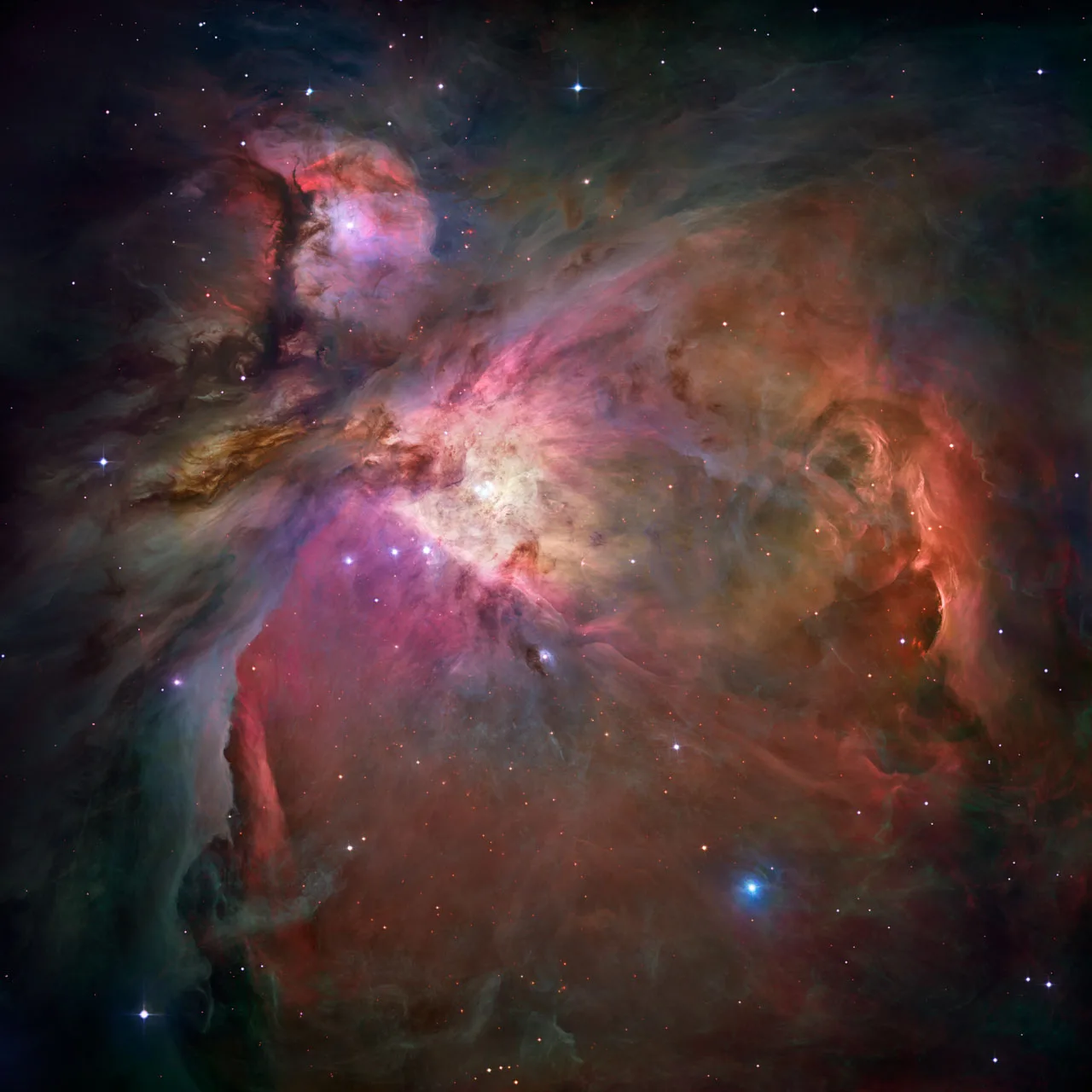
Orion Nebula (M42)
The Orion Nebula, located in Orion’s sword just below the belt, is a brilliant emission nebula. Its bright core and colorful gas clouds make it one of the easiest and most satisfying targets for beginners.
- Type: Emission Nebula
- Constellation: Orion
- Coordinates: RA 05h 35m | Dec -05° 23′
- Location: In Orion’s Sword, just below the Belt.
- Features: Bright, colorful gas clouds and active star formation.
Northern Hemisphere:
- Visibility: Excellent
- Best Months: December to February (Winter)
- Peak Time: Late evening in December; high overhead by midnight.
Southern Hemisphere:
- Visibility: Excellent (Even Better Than in the North)
- Best Months: December to March (Summer)
- Peak Time: High overhead in January, making it easier to capture in detail.
Notable Differences:
- Higher and more prominent in the Southern Hemisphere, with clearer views from latitudes like Australia, New Zealand, and South Africa.
PLAN THIS TARGET — ORION NEBULA (M42) M42 is bright enough for beginners, but framing varies dramatically with focal length and sensor size, and its bright Trapezium core often benefits from shorter exposures blended with longer integrations. The Orion Nebula target guide shows its angular size, best months, equipment suitability, example framing, and a direct route into the Imaging Planner.
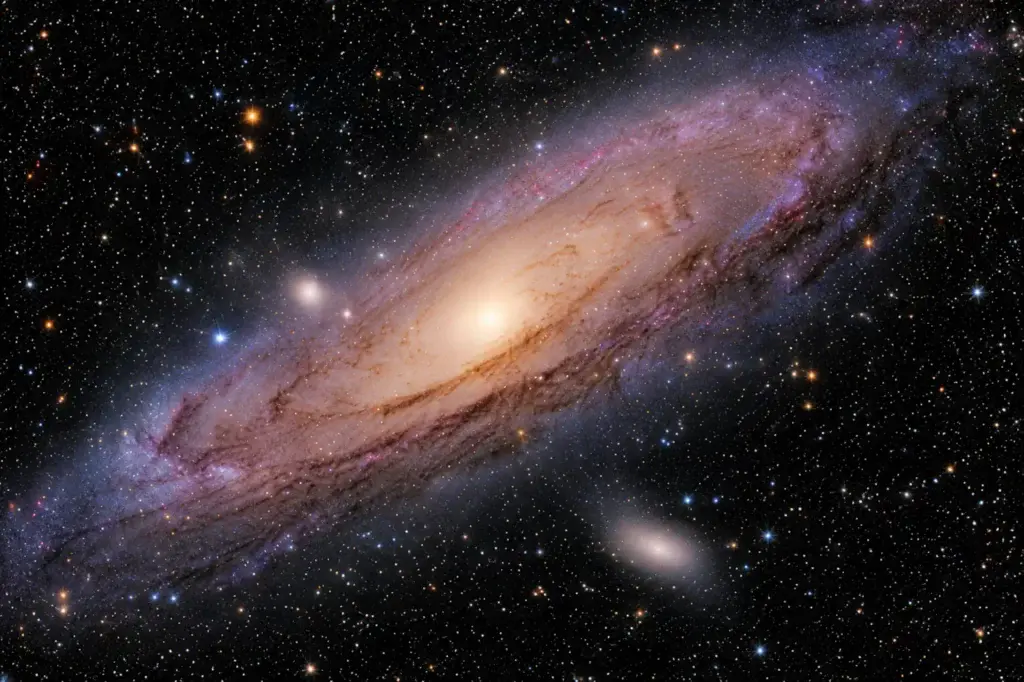
Andromeda Galaxy (M31)
Andromeda is the nearest major galaxy to the Milky Way and is visible to the naked eye in dark-sky conditions. A wide-field telescope or DSLR with a telephoto lens can capture its expansive disk.
- Type: Spiral Galaxy (Face-On)
- Constellation: Andromeda
- Coordinates: RA 00h 42m | Dec +41° 16′
- Location: Near the Great Square of Pegasus.
- Features: Largest neighboring galaxy; visible to the naked eye in dark skies.
Northern Hemisphere:
- Visibility: Excellent
- Best Months: August to November (Autumn)
- Peak Time: Overhead in October, easily located with binoculars.
Southern Hemisphere:
- Visibility: Challenging (Low on Horizon)
- Best Months: August to October (Spring)
- Peak Time: Low in the northern sky, visible from northern Australia or southern Africa.
Notable Differences:
- Best observed from the Northern Hemisphere, as it never climbs high in southern skies.
The Pleiades (M45) (Seven Sisters)
The Pleiades is a bright open cluster easily seen with the naked eye. Long-exposure images reveal a delicate, wispy blue nebula surrounding the stars.
- Type: Open Cluster with Reflection Nebula
- Constellation: Taurus
- Coordinates: RA 03h 47m | Dec +24° 07′
- Location: Near Aldebaran in Taurus.
- Features: Bright blue stars with wispy dust clouds.
Northern Hemisphere:
- Visibility: Excellent
- Best Months: November to February (Winter)
- Peak Time: Overhead around midnight in December.
Southern Hemisphere:
- Visibility: Good (Still Easily Visible)
- Best Months: November to February (Summer)
- Peak Time: High in the north in January.
Notable Differences:
- Visible in both hemispheres but higher and brighter in the Northern Hemisphere.
The Lagoon Nebula (M8)
The Lagoon Nebula is a spectacular target near the heart of the Milky Way. Its pinkish hydrogen emissions and embedded star cluster make it a favorite.
- Type: Emission Nebula with Open Cluster
- Constellation: Sagittarius
- Coordinates: RA 18h 03m | Dec -24° 23′
- Location: In the Milky Way core region, near the “Teapot” asterism.
- Features: Bright hydrogen-alpha regions with dark dust lanes.
Northern Hemisphere:
- Visibility: Good (Low in the South)
- Best Months: June to September (Summer)
- Peak Time: Low in the southern sky in July.
Southern Hemisphere:
- Visibility: Excellent (Directly Overhead)
- Best Months: June to September (Winter)
- Peak Time: Near zenith around midnight in July.
Notable Differences:
- Far superior in the Southern Hemisphere, where it sits high in the sky near the Milky Way core.
The Trifid Nebula (M20)
The Trifid Nebula’s signature trifurcated appearance, with red emission regions and blue reflection areas, makes it an attractive target.
- Type: Emission/Reflection Nebula
- Constellation: Sagittarius
- Coordinates: RA 18h 02m | Dec -23° 02′
- Location: Near the Lagoon Nebula (M8).
- Features: Red emission and blue reflection regions with dark lanes.
Northern Hemisphere:
- Visibility: Good (Low in the South)
- Best Months: June to September (Summer)
- Peak Time: Low in the southern sky in July.
Southern Hemisphere:
- Visibility: Excellent (High Overhead)
- Best Months: June to September (Winter)
- Peak Time: Near the zenith around July.
Notable Differences:
- Like M8, M20 is much easier to capture from the Southern Hemisphere.
The Eagle Nebula (M16) (Pillars of Creation)
Famous for the “Pillars of Creation,” the Eagle Nebula requires longer exposures or narrowband filters to reveal its intricate gas structures.
- Type: Emission Nebula with Open Cluster
- Constellation: Serpens
- Coordinates: RA 18h 18m | Dec -13° 47′
- Location: Near the Sagittarius Arm of the Milky Way.
- Features: Famous for the “Pillars of Creation.”
Northern Hemisphere:
- Visibility: Good (Moderate Altitude)
- Best Months: May to September (Summer)
- Peak Time: High in the southern sky in July.
Southern Hemisphere:
- Visibility: Very Good (Slightly Lower)
- Best Months: May to September (Winter)
- Peak Time: Midway up the northern sky in July.
Notable Differences:
- Higher in the Northern Hemisphere, though easily visible from the south.
The Dumbbell Nebula (M27)
M27’s hourglass shape is easily captured with a moderate telescope and short exposures.
- Type: Planetary Nebula
- Constellation: Vulpecula
- Coordinates: RA 19h 59m | Dec +22° 43′
- Location: Between Cygnus and Sagitta.
- Features: Hourglass-shaped planetary nebula.
Northern Hemisphere:
- Visibility: Good (Moderate Altitude)
- Best Months: July to October (Summer/Autumn)
- Peak Time: High overhead in August.
Southern Hemisphere:
- Visibility: Challenging (Low in the North)
- Best Months: July to October (Winter/Spring)
- Peak Time: Low in the northern sky.
Notable Differences:
- Much easier in the Northern Hemisphere, with limited visibility in the south.
The North America Nebula (NGC 7000)
Wide-field shots capture the nebula’s distinctive “continent” shape near the bright star Deneb.
- Type: Emission Nebula
- Constellation: Cygnus
- Coordinates: RA 20h 58m | Dec +44° 20′
- Location: Near Deneb in Cygnus.
- Features: Nebula shaped like the North American continent.
Northern Hemisphere:
- Visibility: Good (High Altitude)
- Best Months: July to October (Summer/Autumn)
- Peak Time: High overhead in August.
Southern Hemisphere:
- Visibility: ❌ Very Difficult (Near Horizon)
- Best Months: July to October (Winter/Spring)
- Peak Time: Barely above the horizon at best.
Notable Differences:
- A Northern Hemisphere target, barely visible from most southern latitudes.
The Whirlpool Galaxy (M51)
M51’s classic spiral arms make it a popular target, especially when imaged alongside its companion galaxy.
- Type: Spiral Galaxy (Face-On)
- Constellation: Canes Venatici
- Coordinates: RA 13h 29m | Dec +47° 12′
- Location: Near the end of the Big Dipper’s handle.
- Features: Classic spiral galaxy interacting with NGC 5195.
Northern Hemisphere:
- Visibility: Good (High Altitude)
- Best Months: March to June (Spring)
- Peak Time: High overhead in May.
Southern Hemisphere:
- Visibility: ❌ Not Visible (In Most Locations)
- Best Months: April to June (Autumn)
- Peak Time: Extremely low in the northern horizon from latitudes above -20°.
Notable Differences:
- A Northern Hemisphere-only target.
The Rosette Nebula (NGC 2237)
This massive, rose-like structure requires hydrogen-alpha filters to highlight its delicate petals.
- Type: Emission Nebula with Open Cluster
- Constellation: Monoceros
- Coordinates: RA 06h 33m | Dec +04° 59′
- Location: East of Orion.
- Features: Rosette-shaped hydrogen emission region.
Northern Hemisphere:
- Visibility: Good (Moderate Altitude)
- Best Months: December to March (Winter)
- Peak Time: High overhead in January.
Southern Hemisphere:
- Visibility: Good (Moderate Altitude)
- Best Months: December to March (Summer)
- Peak Time: High in the north sky.
Notable Differences:
- Equally impressive from both hemispheres.
Bonus Tips for Capturing Deep-Sky Objects
- Use a Tracking Mount – Long exposures require precise tracking.
- Plan with Stellarium – Free software to predict when objects will be visible.
- Start with Bright Targets – M42 and M31 are beginner-friendly and rewarding.
- Shoot from a Dark Sky Site – Reduces light pollution and increases object visibility.
- Experiment with Filters – Narrowband filters help when shooting in light-polluted areas.
Wherever you are in the world or what time of year it is, our Imaging Planner can help you select the best deep-sky astrophotography targets for tonight!
ASTROPHOTOGURU TIP — TARGET SIZE MATTERS AS MUCH AS TARGET BRIGHTNESS A bright object is not automatically an easy composition. M31 and NGC 7000 cover several degrees of sky, while many galaxies occupy only a small fraction of a wide-field frame. If you are unsure why changing the camera or telescope changes the composition, see our guide to sensor size and image framing and then test the combination in the Imaging Planner.
Final thoughts
Whether you’re aiming a compact refractor at the sweeping dust lanes of the Orion Nebula or pushing a long-focal-length setup to resolve the intricate spiral arms of the Whirlpool Galaxy, deep-sky astrophotography is a journey defined by patience, precision, and continuous learning. Each of these ten targets brings its own unique rewards—and its own distinct calibration and processing challenges. As the seasons shift, so too does the night sky, offering fresh opportunities to refine your tracking, dial in your focus, and stack hours of exposure time into breathtaking final images. Pick the target that best matches your current setup, head out on the next clear night, and let the light from millions of light-years away reveal itself on your sensor.
Top 10 Targets Northern vs Southern Hemisphere
| Object | Type | Constellation | RA/Dec | Northern Hemisphere (Visibility) | Northern Hemisphere (Best Months) | Southern Hemisphere (Visibility) | Southern Hemisphere (Best Months) | Key Differences |
| Orion Nebula (M42) | Emission Nebula | Orion | 05h35m / -05°23' | Excellent | Dec–Feb | Excellent | Dec–Mar | Higher in the sky in the Southern Hemisphere. |
| Andromeda Galaxy (M31) | Spiral Galaxy | Andromeda | 00h42m / +41°16' | Excellent | Aug–Nov | Challenging | Aug–Oct | Low in the sky in the Southern Hemisphere. |
| The Pleiades (M45) | Open Cluster | Taurus | 03h47m / +24°07' | Excellent | Nov–Feb | Good | Nov–Feb | Higher in the Northern Hemisphere. |
| The Lagoon Nebula (M8) | Emission Nebula | Sagittarius | 18h03m / -24°23' | Good | Jun–Sep | Excellent | Jun–Sep | Higher and clearer in the Southern Hemisphere. |
| The Trifid Nebula (M20) | Emission/Reflection Nebula | Sagittarius | 18h02m / -23°02' | Good | Jun–Sep | Excellent | Jun–Sep | More prominent in the Southern Hemisphere. |
| The Eagle Nebula (M16) | Emission Nebula | Serpens | 18h18m / -13°47' | Good | May–Sep | Very Good | May–Sep | Higher in the Northern Hemisphere. |
| The Dumbbell Nebula (M27) | Planetary Nebula | Vulpecula | 19h59m / +22°43' | Good | Jul–Oct | Challenging | Jul–Oct | Higher in the Northern Hemisphere. |
| The North America Nebula (NGC 7000) | Emission Nebula | Cygnus | 20h58m / +44°20' | Good | Jul–Oct | Difficult | Jul–Oct | Rarely visible in the Southern Hemisphere. |
| The Whirlpool Galaxy (M51) | Spiral Galaxy | Canes Venatici | 13h29m / +47°12' | Good | Mar–Jun | Not Visible | Apr–Jun | Not visible in most of the Southern Hemisphere. |
| The Rosette Nebula (NGC 2237) | Emission Nebula | Monoceros | 06h33m / +04°59' | Good | Dec–Mar | Good | Dec–Mar | Equally visible in both hemispheres. |

