If you’re short on time…
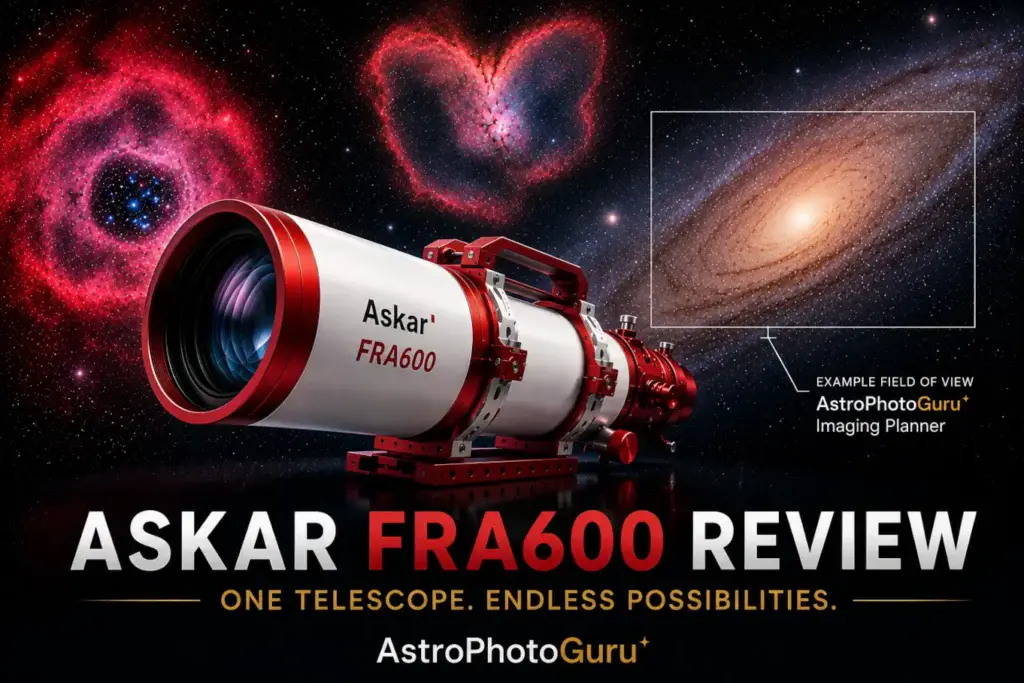
The Askar FRA600 is a premium 108 mm Petzval astrograph designed for serious deep-sky astrophotography. It combines excellent optical correction, a generous 66 mm image circle, and a robust mechanical design into a telescope that performs exceptionally well with both APS-C and full-frame cameras. Add the optional 0.7× focal reducer, and it transforms into an even more versatile wide-field imaging platform.
Quick Verdict
Askar FRA At a Glance
| Verdict | |
| Overall Recommendation | ⭐⭐⭐⭐⭐ Excellent |
| Best For | Deep-sky astrophotography |
| Skill Level | Intermediate to Advanced (ambitious beginners with the right budget will also appreciate it) |
| Camera Compatibility | APS-C and Full Frame |
| Optical Design | Petzval APO with built-in field flattener |
| Ideal Targets | Emission nebulae, dark nebulae, medium-sized galaxies, star fields |
| Optional Accessory | 0.7× focal reducer (420 mm f/3.9) |
| Our Take | One of the most versatile premium astrographs in its class. |
Strengths
- Excellent optical performance with sharp stars across a large image circle.
- True full-frame capability with a generous 66 mm illuminated image circle.
- Built-in Petzval design eliminates the need for a separate field flattener.
- Premium 4.2-inch rack-and-pinion focuser easily supports heavy imaging trains.
- Optional 0.7× reducer transforms the telescope into a fast 420 mm f/3.9 wide-field astrograph.
- Compact 493 mm tube length makes transport and balancing easier than many telescopes with similar focal lengths.
- Outstanding long-term upgrade path for photographers planning to move from APS-C to full-frame cameras.
- Competitive pricing
- Optimized for imaging but great for visual observing also
Considerations
- The optional reducer represents an additional investment for those who want maximum versatility.
- Not well suited for small objects or planets
💡 AstroPhotoGuru Insight
The FRA600 isn’t simply a telescope—it’s an imaging platform. An APS-C camera delivers excellent results today, while the telescope’s oversized 66 mm image circle leaves plenty of room to upgrade to a full-frame camera in the future. Add the optional 0.7× focal reducer, and the same telescope transforms into a fast 420 mm astrograph capable of framing many of the sky’s largest nebulae.
What You’ll Learn in this Review
By the end of this review you’ll understand:
✓ Why the Petzval design matters
✓ APS-C vs Full Frame performance
✓ Whether the 0.7× reducer is worth buying
✓ Which deep-sky targets frame best
✓ Whether the FRA600 fits your imaging goals
Introduction to the Askar FRA600 Review
Choosing a premium astrophotography telescope is about far more than comparing specifications. Aperture, focal length, focal ratio, and optical design all influence the types of celestial objects you can image and the quality of the results you can expect. The challenge is understanding how those specifications translate into real-world performance.
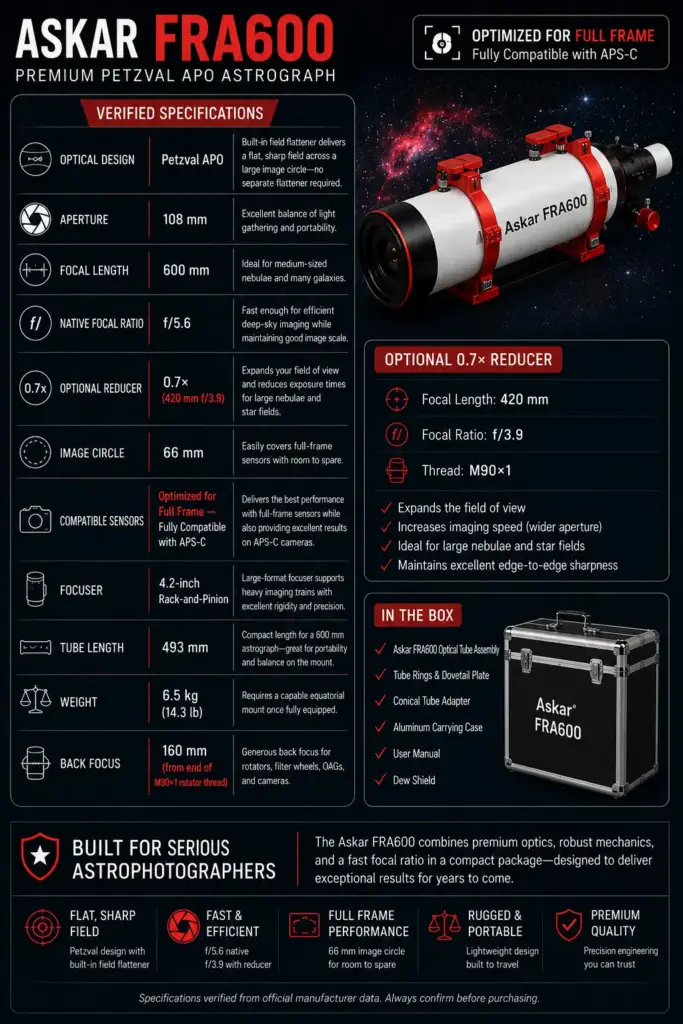
The Askar FRA600 is designed specifically for astrophotographers who want a telescope that delivers professional-level imaging without requiring a collection of additional optical accessories. Its Petzval optical design incorporates a built-in field flattener, producing a naturally flat imaging field across a generous 66 mm image circle. Combined with a 108 mm aperture, 600 mm focal length, and a 4.2-inch rack-and-pinion focuser, the FRA600 is engineered to support modern APS-C and full-frame imaging systems with confidence.
What makes the FRA600 especially compelling is its versatility. At its native 600 mm focal length (f/5.6), it excels on many medium-sized nebulae and galaxies. Pair it with the optional 0.7× focal reducer, and it becomes a 420 mm f/3.9 wide-field astrograph capable of capturing many of the sky’s largest emission nebulae in a single frame.
This review goes beyond a traditional specification sheet. Rather than simply listing features, we’ll explore what each specification means, how different camera sensor sizes affect framing, when the optional reducer is worth the investment, and which deep-sky targets are best suited to each configuration. Throughout the review, you’ll also see data-driven visualizations created with the AstroPhotoGuru Imaging Planner, providing objective guidance to help you plan your own imaging sessions.
Whether you’re considering your first premium astrograph or upgrading to a full-frame imaging system, this review is designed to help you understand not only what the Askar FRA600 offers, but why those features matter when you’re under the stars.
💡 AstroPhotoGuru Insight
Specifications tell you what a telescope is. Understanding how those specifications affect framing, image quality, and target selection tells you what the telescope can do. That’s the philosophy behind every AstroPhotoGuru review.
Ready to learn more?

If you're considering the Askar FRA600 for your next astrophotography system, you can check current pricing and availability here:

👉 Check the current price
This askar fra600 review highlights the impressive capabilities of this astrophotography telescope.
Understanding the Specifications: Why They Matter
The Askar FRA600’s specifications tell only part of the story. Numbers like aperture, focal length, focal ratio, and image circle are easy to compare on a product sheet, but understanding how they influence your images is far more important.
In this section, we’ll explain what each key specification means in practical terms and how it contributes to the FRA600’s performance as a deep-sky imaging telescope.
Aperture
The 108 mm aperture is the telescope’s light-collecting lens. A larger aperture gathers more light, allowing fainter celestial objects to be recorded with better signal-to-noise ratio and finer detail.
For deep-sky astrophotography, aperture influences more than image brightness. It also determines the telescope’s theoretical resolving power—the ability to distinguish fine details within galaxies, nebulae, and star clusters.
At 108 mm, the FRA600 strikes an excellent balance between light-gathering capability, portability, and manageable weight. It’s large enough to produce detailed deep-sky images while remaining practical for transport and compatible with a wide range of equatorial mounts. Larger aperture refractors become too long and heavy to be a reasonable travel scope. We would consider anything larger than 108mm to be mostly impractical for traveling to remote locations.
💡 AstroPhotoGuru Insight
Bigger isn’t always better. For astrophotography, a well-corrected optical system with excellent tracking will almost always outperform a larger telescope suffering from poor seeing or inadequate mount performance.
Focal Length
Focal length determines how much of the sky your camera captures. Unlike aperture, it doesn’t make the telescope more powerful—it changes the field of view and image scale.
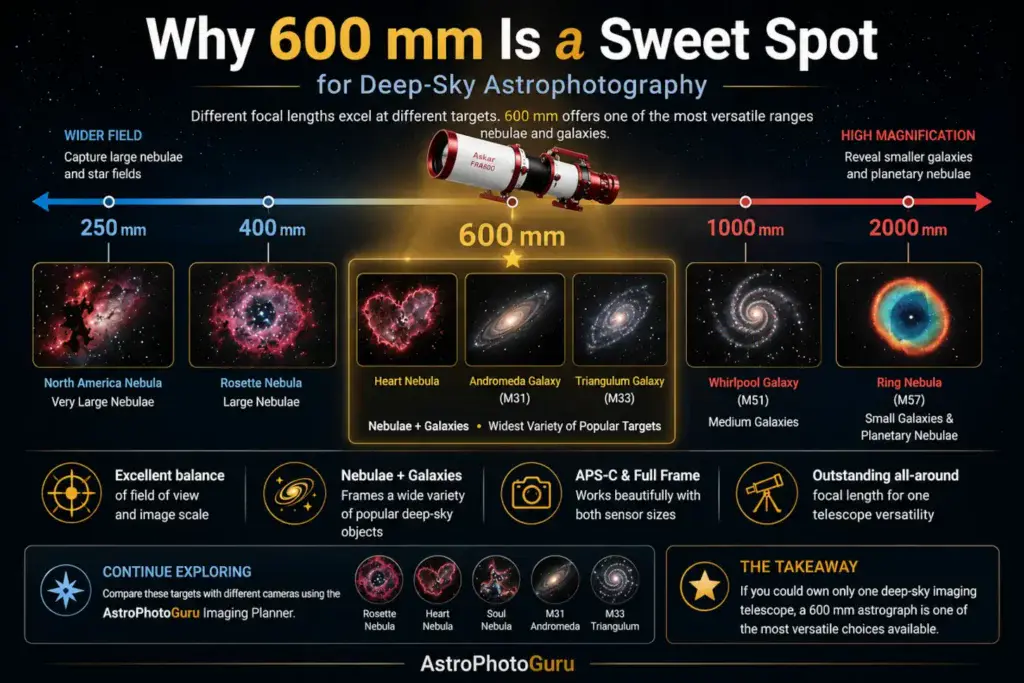
At 600 mm, the FRA600 is well suited to medium-sized deep-sky objects such as the Rosette Nebula, Lagoon Nebula, Orion Nebula, and many galaxies. It also provides enough resolution to reveal structure within these objects without requiring the long exposures often associated with much longer focal lengths.
One of the strengths of a 600 mm astrograph is its versatility. It’s long enough to capture detail, yet short enough to remain forgiving of guiding errors and atmospheric seeing.
🎯 Planning Tip
Before choosing a telescope, think about the objects you want to image—not the magnification. Matching focal length to your favorite targets is one of the best ways to improve your astrophotography experience.
Native f/5.6 Focal Ratio
The FRA600 operates at a native focal ratio of f/5.6, providing an excellent balance between image scale and imaging efficiency. This focal ratio would be considered on the fast side.
A faster focal ratio allows more light to reach the camera sensor in a given amount of time, reducing the exposure needed to achieve a desired signal. While factors such as sky conditions, filters, and camera sensitivity also affect exposure length, the native f/5.6 system is well-suited for a wide range of deep-sky imaging projects.
When paired with the optional 0.7× focal reducer, the telescope becomes 420 mm at f/3.9, increasing the field of view while collecting light more efficiently.
Petzval Optical Design
Unlike many refractors that require a separate field flattener, the FRA600 uses a Petzval optical design with built-in field flattening optics.
The primary advantage is simplicity. Once the camera is positioned at the correct back focus, the telescope is designed to produce a flat imaging field without requiring additional corrective optics. External field-flatteners require precise positioning to function at their best. This adds an additional often complicated step to set up the optical train. The Petzval design reduces setup complexity while helping maintain sharp stars from the center of the image to the corners of modern APS-C and full-frame sensors.
⚙️ Technical Note
A Petzval telescope integrates the field flattener into the optical design. This eliminates the need for a separate flattener that many conventional triplet refractors require for astrophotography.
Image Circle
One of the FRA600’s standout specifications is its 66 mm image circle.
Many refractors are designed primarily around APS-C sensors or require careful optical matching to illuminate a full-frame camera without noticeable vignetting or edge degradation. The FRA600’s generous image circle is designed to comfortably support modern full-frame sensors while also providing excellent performance with APS-C cameras.
This means photographers can begin with an APS-C camera today and later upgrade to a full-frame system without replacing their telescope.
💡 AstroPhotoGuru Insight
The image circle doesn’t make your pictures better—it determines how much of your camera sensor can be fully illuminated with sharp, well-corrected stars. A larger image circle gives you more flexibility when choosing or upgrading cameras.
4.2-inch Rack-and-Pinion Focuser
Astrophotography equipment has become increasingly heavy. Large cooled cameras, filter wheels, off-axis guiders, electronic focusers, and rotators can place significant demands on a telescope’s focuser.
The FRA600 addresses this with a 4.2-inch rack-and-pinion focuser designed to provide excellent rigidity and precise focusing while supporting substantial imaging trains.
A rigid focuser is particularly important during long imaging sessions, helping maintain focus and minimize flexure as the telescope tracks across the night sky.
Back Focus
The FRA600 provides 160 mm of available back focus, measured from the end of the M90×1 rotator thread.
This generous spacing offers flexibility when assembling an imaging train that includes accessories such as rotators, filter wheels, off-axis guiders, and cooled astronomy cameras.
Rather than forcing photographers into a tightly constrained optical path, the FRA600 provides room to build a sophisticated imaging system while maintaining proper optical spacing.
Bringing It All Together
No single specification defines the Askar FRA600. Its strength comes from how these features work together. The combination of a 108 mm aperture, 600 mm focal length, Petzval optical design, 66 mm image circle, 4.2-inch rack-and-pinion focuser, and optional 0.7× reducer creates a telescope that is equally at home with APS-C and full-frame cameras and capable of imaging a remarkably broad range of deep-sky targets.
Build Quality
A telescope’s optical performance often receives the most attention, but its mechanical design plays an equally important role in successful astrophotography. Even the finest optics cannot compensate for a focuser that flexes under the weight of a camera, mounting hardware that shifts during an imaging session, or a tube assembly that fails to maintain precise alignment throughout the night.
The Askar FRA600 is clearly designed with imaging in mind. From its rigid tube assembly to its oversized focuser and precision-machined components, every aspect of its construction reflects the needs of modern astrophotographers using increasingly sophisticated imaging systems.
Tube Construction
The FRA600 features a robust CNC-machined aluminum optical tube designed to provide excellent rigidity while remaining compact for a telescope with a 600 mm focal length. At just 493 mm in length, the optical tube is shorter than many refractors of similar focal length, making it easier to transport, balance, and store.
A rigid tube is more than a convenience—it helps maintain optical alignment and consistent focus as the telescope tracks across the sky throughout the night.
💡 AstroPhotoGuru Insight- callout
A shorter tube isn’t just easier to transport. It also reduces the moment arm acting on your mount, making balancing easier and helping maintain stable guiding during long imaging sessions.
Mounting Rings and Dovetail
The FRA600 includes heavy-duty mounting rings and a sturdy dovetail plate designed to provide a secure connection between the telescope and equatorial mount.
The red anodized rings are both functional and visually distinctive, distributing the telescope’s weight evenly while allowing accessories such as guide scopes, mini computers, or power distribution systems to be mounted securely.
For astrophotography, minimizing mechanical flexure is essential. A solid mounting system helps preserve accurate guiding and consistent framing throughout an imaging session.
Precision Camera Rotator
One feature often overlooked on many telescopes is the integrated camera rotator. This type of field rotator is becoming very common among high-end refractors.
The FRA600 incorporates a precision rotator that makes it easy to adjust image orientation without disturbing focus or altering the optical spacing of the imaging train.
This is particularly useful when composing large nebulae or framing elongated galaxies, allowing photographers to rotate the camera to achieve the most pleasing composition while maintaining accurate back focus.
🎯 Planning Tip
Spend a few moments rotating your camera before beginning an imaging session. A small change in orientation can dramatically improve the composition of many deep-sky targets.
Focuser
We discuss the importance of the sturdy 4.2-inch focuser above.
⚙️ Technical Note
The larger the focuser, the greater its ability to illuminate large sensors and support heavy imaging equipment with minimal flexure. A 4.2-inch focuser is a hallmark of a premium imaging telescope.
Fit and Finish
The FRA600 exhibits the level of machining and finish expected from a premium astrograph. Components fit together precisely, controls operate smoothly, and the telescope conveys a reassuring sense of mechanical quality.
The white optical tube, red anodized mounting rings, and black accents create a distinctive appearance while reflecting the attention to detail found throughout the instrument.
Although appearance does not improve image quality, careful machining and robust construction contribute directly to long-term reliability—an important consideration for equipment expected to perform night after night under varying environmental conditions.
Bringing It All Together
Excellent optics deserve equally capable mechanics. The Askar FRA600 combines a compact tube, rigid mounting system, precision rotator, oversized 4.2-inch focuser, and high-quality machining into a mechanical platform that complements its optical performance. For astrophotographers building a long-term imaging system, these features inspire confidence that the telescope will remain stable and reliable as imaging equipment evolves.
Key Takeaway
The FRA600’s premium mechanical construction isn’t simply about aesthetics. Every component—from the compact tube to the 4.2-inch focuser—is designed to support the precision and stability required for modern deep-sky astrophotography.
Callout- Excellent mechanics provide the foundation for a successful imaging system—but ultimately an astrograph is judged by the quality of the images it produces.
Optical Performance
The true measure of an astrograph isn’t found on its specification sheet—it’s revealed in the images it produces. Sharp stars, accurate color, a flat imaging field, and consistent performance across the sensor are the characteristics that determine whether a telescope becomes a trusted imaging companion or a source of constant frustration.
The Askar FRA600 was engineered from the outset as a dedicated astrophotography instrument. Its Petzval optical design, generous 66 mm image circle, and premium mechanical construction are all intended to work together to deliver consistent, high-quality images across both APS-C and full-frame sensors.
Let’s take a closer look at the optical characteristics that define its performance.
Color Correction
One of the primary advantages of a premium apochromatic refractor is its ability to bring different wavelengths of light to the same focal plane. Poor color correction can produce purple halos around bright stars and reduce fine detail, particularly when using modern high-resolution cameras.
The FRA600’s Petzval APO design is engineered to minimize chromatic aberration, producing clean, well-defined stars and accurate color rendition across the visible spectrum. This is especially important for broadband imaging, where accurate stellar color contributes to a natural-looking final image.
For astrophotographers, effective color correction means less time correcting optical artifacts during post-processing and more time refining the image itself.
💡 AstroPhotoGuru Insight
Good color correction isn’t just about eliminating purple halos. It preserves fine stellar detail and allows the natural colors of stars and nebulae to shine through without fighting optical artifacts in post-processing.
Flat-Field Performance
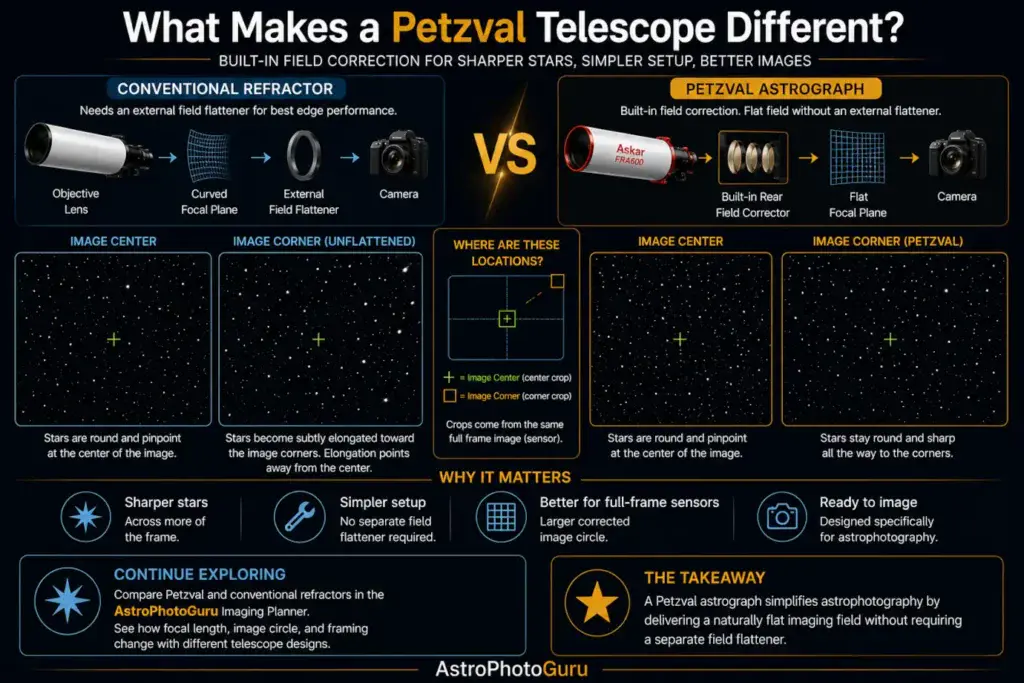
A flat imaging field is one of the defining characteristics of the FRA600.
Traditional refractors often require an external field flattener to maintain sharp stars toward the edges of the image, particularly when paired with larger camera sensors. Because the FRA600 incorporates a Petzval optical design, the field flattener is built into the telescope itself.
The result is a naturally flat imaging plane designed to maintain star quality across a large sensor without the need for additional corrective optics.
This integrated approach simplifies setup while reducing one more variable in the imaging train.
⚙️ Technical Note
A flat field means stars remain sharp from the center of the frame to the corners. This becomes increasingly important as sensor size increases, particularly with full-frame cameras.
Corner Star Performance
Corner performance is often where an astrograph reveals the quality of its optical design.
Small sensors may never expose weaknesses near the edge of the image circle, but full-frame cameras place much greater demands on the telescope. The FRA600’s generous 66 mm image circle is designed to comfortably illuminate both APS-C and full-frame sensors while maintaining excellent correction across the field.
For photographers planning to use modern high-resolution full-frame cameras, this large image circle provides valuable flexibility and helps preserve star quality across the entire sensor.
🎯 Planning Tip
Even if you’re currently using an APS-C camera, purchasing a telescope with a large image circle gives you the freedom to upgrade to full frame later without replacing your optics.
Contrast and Image Quality
Contrast is one of the more subtle aspects of optical performance, yet it has a significant impact on the appearance of deep-sky images.
High contrast allows faint dust lanes, delicate nebulosity, and subtle variations in brightness to stand out more clearly from the background sky. While sky conditions, filters, and processing techniques all influence the final result, a well-corrected optical system provides an excellent foundation.
Combined with its moderate focal length and premium optical design, the FRA600 is well suited to revealing fine structure in emission nebulae, reflection nebulae, dark nebulae, and many medium-sized galaxies.
A System Designed for Modern Cameras
One of the FRA600’s greatest strengths is that its optical design was developed with today’s imaging sensors in mind.
Modern astrophotographers expect telescopes to support:
- APS-C and full-frame cameras
- Large filter wheels
- Electronic focusers
- Rotators
- High-resolution sensors
The FRA600’s combination of a 66 mm image circle, integrated field flattener, generous back focus, and robust mechanical design reflects this modern philosophy. Rather than requiring multiple optical accessories to achieve optimal performance, the telescope arrives as a highly integrated imaging platform ready to accommodate a wide range of equipment.
🌌 Under the Stars
The best astrograph is one that disappears into the background, allowing you to focus on collecting photons instead of solving optical problems. The FRA600’s integrated Petzval design is intended to do exactly that—simplify the imaging experience while delivering consistent optical performance.
The FRA600’s large image circle is designed to support both APS-C and full-frame cameras—but what difference does sensor size actually make? Before we explore the optional focal reducer, it’s worth understanding how your choice of camera changes the portion of the sky you capture.
APS-C vs. Full-Frame Sensors
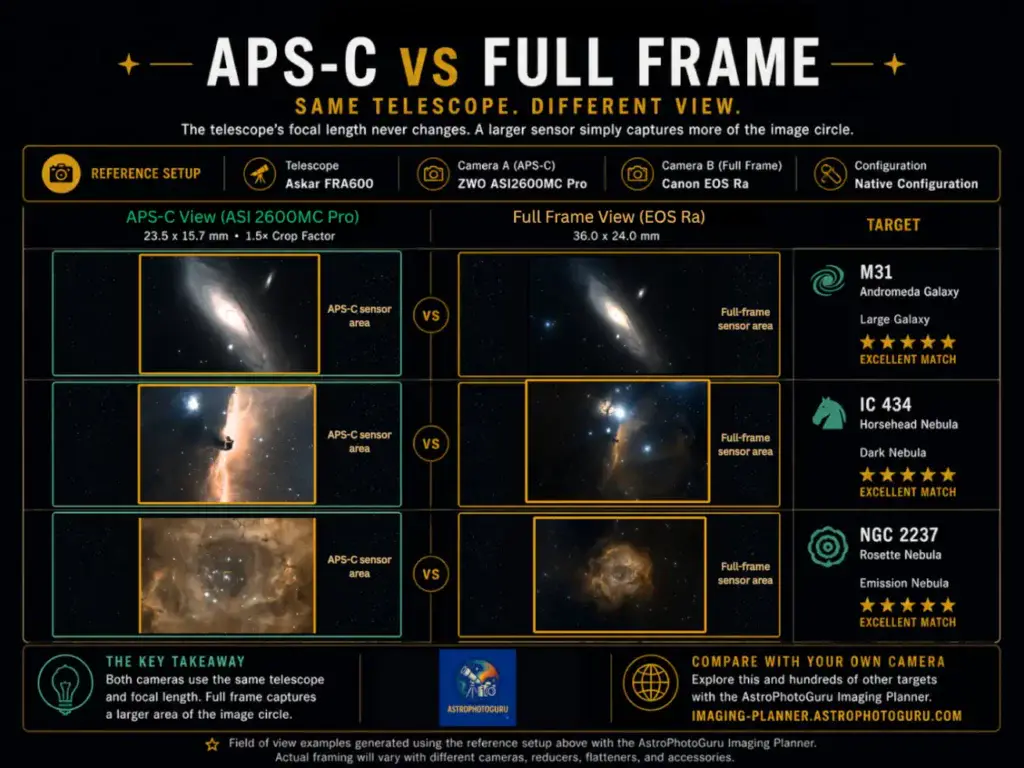
One of the Askar FRA600’s greatest strengths is its ability to perform exceptionally well with both APS-C and full-frame cameras. Thanks to its generous 66 mm image circle, the telescope comfortably illuminates either sensor format without requiring different optical configurations.
What changes is not the telescope, but how much of the sky your camera records.
💡 AstroPhotoGuru Insight
Think of the telescope as a movie projector. Changing the camera sensor is like changing the size of the movie screen—you see more or less of the projected image, but the projector itself never changes.
APS-C: A Closer View
APS-C cameras record a smaller portion of the image circle, resulting in a tighter field of view.
This can be advantageous for:
- Medium-sized and small galaxies
- Planetary nebulae
- Smaller emission nebulae
- Globular clusters
Because the subject occupies a larger portion of the frame, many photographers feel that APS-C provides “more reach.” In reality, it simply crops the outer portion of the image that a full-frame camera would also record.
For astrophotographers who already own an APS-C camera, the FRA600 provides excellent performance while leaving room for future upgrades.
Full Frame: More Sky in Every Image
A full-frame sensor captures much more of the telescope’s image circle, revealing a wider field of view.
This becomes particularly valuable when imaging:
- Large emission nebulae
- Extended dark nebulae
- Wide star fields
- Large molecular cloud complexes
Objects such as the North America Nebula, California Nebula, and portions of the Veil Nebula benefit from the additional framing provided by a full-frame sensor.
The FRA600’s 66 mm image circle was designed specifically to support cameras of this size, allowing photographers to take full advantage of the available field.
🎯 Planning Tip
If you’re deciding between APS-C and full frame, choose based on the types of objects you enjoy imaging—not because one sensor format is universally better than the other.
Which Sensor Should You Choose?
Both formats have distinct advantages.
An APS-C camera offers a tighter composition on smaller targets and can be an excellent choice for photographers building their first dedicated imaging system.
A full-frame camera expands the available field of view, making it easier to frame large nebulae while taking full advantage of the FRA600’s large flat field.
Perhaps the most compelling aspect of the FRA600 is that it doesn’t force you to choose. The telescope performs exceptionally well with both formats, allowing photographers to begin with an APS-C camera and later upgrade to full frame without changing telescopes. The optional focal reducer offers even greater flexibility.
🌌 Future Flexibility
One of the biggest advantages of investing in a telescope with a large image circle is that your camera can evolve over time. Today’s APS-C imaging system can become tomorrow’s full-frame setup without replacing the optical tube.
🚫 Common Misconception
“An APS-C camera increases the telescope’s magnification.”
Reality: The telescope’s focal length remains exactly the same. An APS-C sensor simply records a smaller portion of the image projected by the telescope, producing a narrower field of view.
Native vs. 0.7× Focal Reducer
One of the Askar FRA600’s greatest strengths is its versatility. At first glance, it is a premium 600 mm f/5.6 astrograph designed for medium-sized deep-sky objects. Add the optional 0.7× focal reducer, however, and the telescope takes on an entirely different personality.
Rather than simply changing a specification, the reducer expands the range of objects the FRA600 can frame while increasing its imaging speed. It’s less about making the telescope “better” and more about making it adaptable to a broader variety of imaging projects.
One Telescope. Two Imaging Personalities
At its native configuration, the FRA600 offers a 600 mm focal length at f/5.6, providing an excellent balance of image scale and field of view for many medium-sized galaxies and nebulae.
Installing the optional 0.7× focal reducer changes two important characteristics:
- The focal length decreases from 600 mm to 420 mm.
- The focal ratio decreases from f/5.6 to f/3.9.
These changes create a wider field of view. And decreasing the focal ratio makes it an even faster telescope, allowing faster capture of light over a larger area of the sky more efficiently.
💡 AstroPhotoGuru Insight
The focal reducer doesn’t replace the telescope’s native configuration—it complements it. Think of it as adding a second telescope to your imaging toolkit without purchasing a second optical tube.
Native Configuration (600 mm, f/5.6)
The native configuration is particularly well suited to targets that benefit from a little more image scale without requiring extremely long focal lengths.
Examples include:
- Rosette Nebula
- Orion Nebula
- Lagoon Nebula
- Trifid Nebula
- Pinwheel Galaxy
- Whirlpool Galaxy
At 600 mm, these objects occupy a larger portion of the frame while still leaving room for pleasing composition.
With the 0.7× Reducer (420 mm, f/3.9)
Adding the optional reducer transforms the FRA600 into a fast 420 mm f/3.9 astrograph.
This wider field of view is especially beneficial for:
- Veil Nebula
- North America Nebula
- California Nebula
- Heart & Soul Nebula
- Large molecular cloud complexes
- Extended star fields
The faster focal ratio also improves imaging efficiency, making it easier to collect signal during shorter nights or under changing weather conditions.
🎯 Planning Tip
If your imaging sessions are dominated by large emission nebulae, the optional reducer is one of the most valuable accessories you can add to the FRA600.
Which Configuration Should You Choose?
The answer depends entirely on your preferred targets.
If your interests lean toward medium-sized galaxies and nebulae, the native 600 mm configuration provides an excellent balance between image scale and framing.
If your favorite objects are expansive emission nebulae or large molecular cloud complexes, the 420 mm configuration allows many of these targets to fit comfortably within the frame while reducing the exposure time needed to achieve a comparable signal.
The important point is that neither configuration is universally superior. Each is optimized for a different style of astrophotography
Recommended Accessory

If you decide to purchase the FRA600, I strongly recommend considering the optional 0.7× focal reducer at the same time. It expands the telescope's versatility significantly and is one of the most valuable upgrades available.

👉 View the Askar FRA600 0.7× Reducer
🌌 Under the Stars
Many experienced astrophotographers eventually discover that their favorite telescope isn’t the one with the longest focal length—it’s the one that frames the greatest variety of targets. The optional 0.7× reducer dramatically expands the FRA600’s versatility without requiring a second telescope.
Key Takeaway
The optional 0.7× focal reducer doesn’t simply make the FRA600 faster or wider. It effectively gives astrophotographers two complementary imaging systems in a single telescope: a 600 mm f/5.6 configuration for medium-sized deep-sky objects and a 420 mm f/3.9 configuration that excels on large nebulae and sweeping star fields. Choosing between them isn’t about which is better—it’s about selecting the configuration that best matches your imaging goals.
🚫 Common Misconception
“A focal reducer always improves every image.”
Reality: A focal reducer changes the telescope’s capabilities—it doesn’t universally improve them. Focal reducers often serve a dual purpose: they also are field-flatteners, which improve the star images at the periphery. This is helpful for refractors that are not a Petzval design. For the FRA600 the focal reducer provides a wider field of view and a faster focal ratio, but it also reduces image scale. For smaller galaxies or compact nebulae, the native 600 mm configuration often provides a more pleasing composition. The best choice depends on the target you plan to image.
Should You Buy the Optional 0.7× Focal Reducer?
The answer depends on the types of deep-sky objects you enjoy imaging.
✔ Buy the Reducer if you:
- Frequently image large emission nebulae.
- Want a wider field of view without purchasing a second telescope.
- Value faster imaging with the f/3.9 focal ratio.
- Use a full-frame camera and want to maximize the field of view.
- Want the flexibility to image a broader range of targets.
You May Not Need the Reducer if you:
- Primarily image medium-sized galaxies.
- Prefer a tighter composition on smaller nebulae.
- Are satisfied with the native 600 mm f/5.6 configuration.
- Want to minimize additional equipment costs.
⭐ AstroPhotoGuru Recommendation
If your budget allows, the optional 0.7× focal reducer is one of the most worthwhile accessories for the FRA600. It effectively transforms one telescope into two capable imaging systems, giving you the flexibility to frame both medium-sized and expansive deep-sky objects without purchasing a second optical tube.
💡 Planning Tip
If you’re unsure whether you’ll benefit from the reducer, think about your favorite targets—not your favorite specifications. If your imaging list is dominated by large nebulae like the Veil, North America, California, or Heart & Soul Nebulae, the reducer will likely become one of your most-used accessories.
Buying Advice
If you’re choosing between investing in a premium telescope or upgrading your camera, the telescope usually provides a much longer service life. A quality astrograph like the FRA600 can remain the foundation of your imaging system through multiple camera upgrades.
What Can You Image? A Target Framing Guide
One of the first questions astrophotographers ask after choosing a telescope is, “What can I image with it?” The answer depends on several factors, including focal length, camera sensor size, and—if you’re using one—whether a focal reducer is part of your imaging system.
Rather than relying on a handful of example photographs, the AstroPhotoGuru Imaging Planner evaluates how well different deep-sky objects are framed with a specific telescope and camera combination. This objective approach allows you to compare equipment configurations and choose the one that best matches your imaging goals.
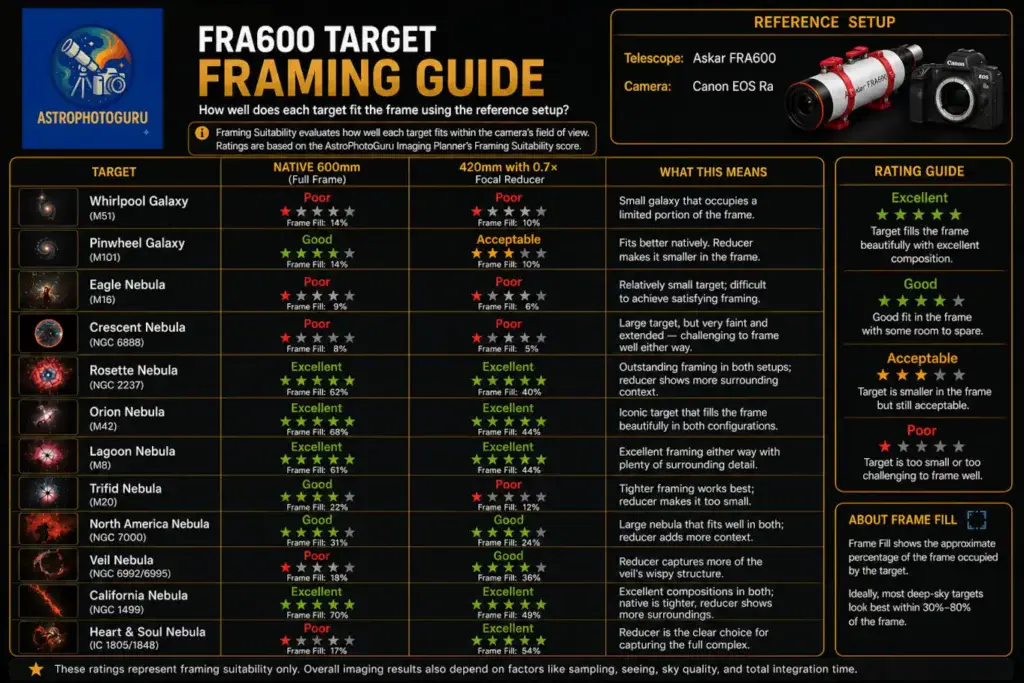
The following guide uses the Askar FRA600 paired with a Canon EOS Ra full-frame camera to compare the telescope at its native 600 mm focal length and with the optional 0.7× focal reducer (420 mm).
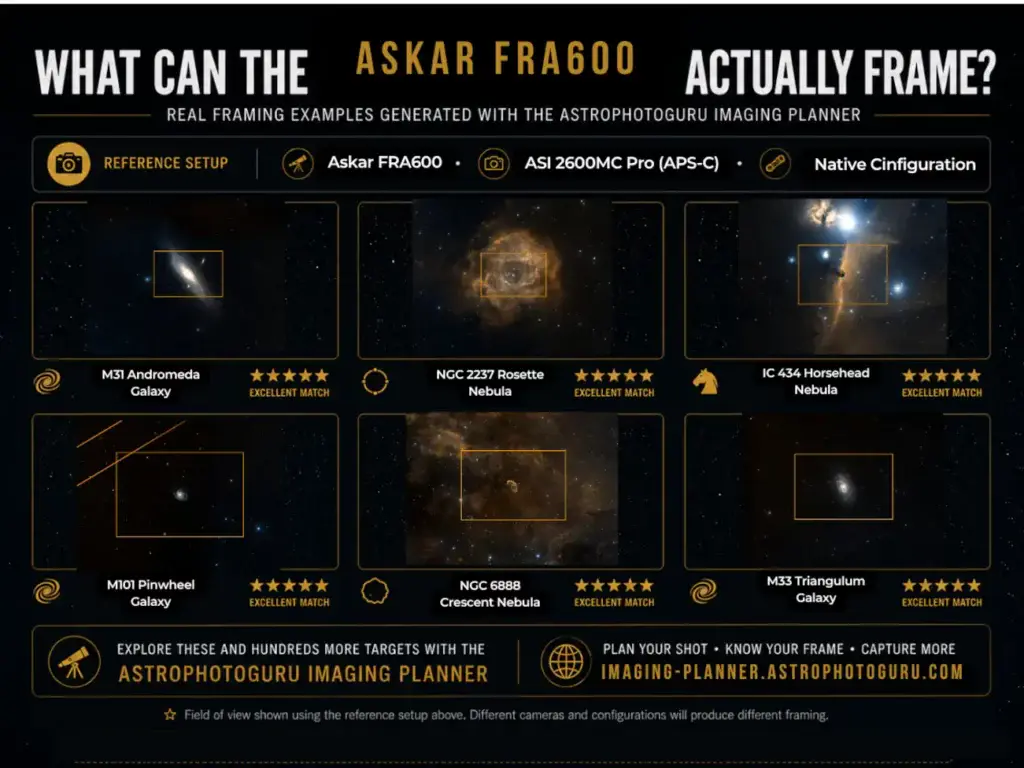
The examples above show just a small sample of the deep-sky objects the FRA600 can capture. But how do you know whether a particular target is ideally framed—or whether the optional 0.7× reducer would provide a better composition?
Understanding the Framing Suitability Ratings
The ratings shown in the guide are based on the Framing Suitability analysis generated by the AstroPhotoGuru Imaging Planner.
Unlike an overall equipment recommendation, Framing Suitability evaluates only how well a target fits within the camera’s field of view. It does not consider image scale, sampling, tracking accuracy, or other factors that contribute to overall imaging performance.
This makes it an excellent tool for deciding which optical configuration is best suited for a particular target.
💡 AstroPhotoGuru Insight
A telescope doesn’t have to frame every target perfectly to be an outstanding astrograph. The goal is to choose the configuration that best matches the object you plan to image.
What the framing Guide Reveals
One of the most interesting observations is that the optional focal reducer doesn’t simply improve framing—it changes the telescope’s strengths.
At its native 600 mm focal length, the FRA600 excels on many medium-sized nebulae, providing a balanced composition that fills the frame without excessive cropping.
With the 0.7× reducer, the wider field of view makes the telescope a much better match for expansive emission nebulae such as the Veil Nebula and the Heart & Soul Nebulae, while the faster f/3.9 focal ratio improves imaging efficiency.
Meanwhile, objects like the Rosette Nebula, Orion Nebula, and California Nebula remain excellent choices in either configuration, demonstrating the versatility of the FRA600 across a wide range of targets.
🎯 Planning Tip
Don’t choose your telescope based on one favorite object. Choose it based on the kinds of targets you expect to image most often over the coming years.
Using the Imaging Planner
The Target Framing Guide is only a starting point.
The AstroPhotoGuru Imaging Planner allows you to explore hundreds of deep-sky objects using your own equipment. Simply select your telescope, camera, and optional accessories to see how different targets are framed before you spend a night under the stars.
Whether you’re planning a single imaging session or deciding between equipment upgrades, the planner helps remove much of the guesswork from target selection.
🌌 Under the Stars
The best imaging nights begin long before sunset. Knowing which targets are ideally framed by your equipment lets you spend more time collecting photons and less time wondering what to image next.
Key Takeaway
The Askar FRA600 is capable of imaging an impressive variety of deep-sky objects, but its versatility truly shines when paired with the optional 0.7× focal reducer. Rather than forcing one configuration to fit every target, the combination of native and reduced focal lengths allows astrophotographers to choose the framing that best complements each object. The AstroPhotoGuru Imaging Planner makes those decisions objective, helping you select the right configuration before your imaging session begins.
🚫 Common Misconception
“A telescope is either good or bad for a target.”
Reality: Target suitability depends on the entire imaging system—including the telescope, camera sensor, and accessories. The same telescope can provide very different framing for the same object depending on whether you’re using an APS-C or full-frame camera, or whether a focal reducer is installed.
Plan Before You Point
The best astrophotography begins with good planning. Explore hundreds of deep-sky targets using the AstroPhotoGuru Imaging Planner and discover which objects are framed best by your own telescope, camera, and accessories—before your next night under the stars.
Questions Astrophotographers Ask
1. Is the Askar FRA600 worth the money?
A premium astrograph that offers excellent optical performance, full-frame compatibility, and long-term versatility. For astrophotographers planning to build a serious imaging system, it represents a strong long-term investment.
2. Is the Askar FRA600 good for beginners?
Yes—provided your goal is astrophotography rather than casual visual observing. While it requires a capable mount and represents a significant investment, it offers plenty of room to grow as your skills and equipment evolve.
3. Does the Askar FRA600 support full-frame cameras?
Yes. Its generous 66 mm image circle was designed to illuminate full-frame sensors while remaining fully compatible with APS-C cameras.
4. Do I need the optional 0.7× focal reducer?
Not necessarily. The native 600 mm configuration is excellent for many targets. The reducer is most valuable if you frequently image large nebulae or want a wider field of view and a faster f/3.9 focal ratio.
5. What mount should I use with the FRA600?
Choose a mount with enough capacity to comfortably support the telescope, camera, guider, filters, and other accessories. Since the fully equipped system is considerably heavier than the optical tube alone, a quality equatorial mount is essential for reliable long-exposure imaging.
6. What objects is the FRA600 best suited for?
The FRA600 excels on emission nebulae, reflection nebulae, dark nebulae, open clusters, and many medium-sized galaxies. Adding the optional reducer expands its capabilities for very large nebulae and sweeping star fields.
7. Can I use the FRA600 for visual observing?
Yes. Although it was designed primarily as an astrograph, the FRA600 also performs well for visual observations of the Moon, star clusters, and brighter deep-sky objects when paired with suitable eyepieces.
8. What cameras work best with the FRA600?
The FRA600 performs exceptionally well with dedicated astronomy cameras, DSLRs, and mirrorless cameras. Both APS-C and full-frame sensors are well supported, allowing photographers to choose the format that best matches their imaging goals.
9. What makes the FRA600 different from a standard triplet refractor?
Its Petzval optical design incorporates a built-in field flattener, eliminating the need for a separate flattener while producing a naturally flat imaging field across a large image circle.
10. Who should buy the Askar FRA600?
The FRA600 is an excellent choice for astrophotographers seeking a premium, long-term imaging telescope. Its combination of optical quality, mechanical precision, full-frame support, and reducer compatibility makes it suitable for everyone from committed beginners to experienced imagers looking for a versatile astrograph.
Final Verdict
The Askar FRA600 isn’t simply another premium refractor—it is a purpose-built imaging platform designed for modern astrophotography. Throughout this review we’ve looked beyond the specifications to understand how its optical design, mechanical construction, and real-world framing capabilities work together to create a remarkably versatile telescope.
Its 108 mm Petzval optical system, generous 66 mm image circle, premium 4.2-inch rack-and-pinion focuser, and support for both APS-C and full-frame cameras make it a telescope capable of producing excellent results today while remaining ready for tomorrow’s equipment upgrades.
What impressed us most is its versatility. At its native 600 mm focal length, the FRA600 excels on many of the sky’s most popular nebulae and medium-sized galaxies. Add the optional 0.7× focal reducer, and the same telescope transforms into a fast 420 mm f/3.9 astrograph capable of beautifully framing expansive emission nebulae and wide-field deep-sky scenes.
No telescope is perfect for every application. The FRA600 represents a premium investment and requires a capable equatorial mount to realize its full potential. It is also unapologetically designed for astrophotography rather than casual visual observing. Those are not shortcomings—they are the natural trade-offs of a telescope engineered with a very specific mission in mind.
For photographers seeking a long-term imaging telescope that can grow with their skills, accommodate both APS-C and full-frame cameras, and adapt to an exceptionally broad range of deep-sky targets, the Askar FRA600 stands out as one of the most compelling premium astrographs in its class.
⭐ Our Recommendation
We highly recommend the Askar FRA600 for astrophotographers who want a premium, full-frame-capable imaging telescope that combines outstanding optics, robust mechanics, and exceptional versatility.
Rather than trying to be everything to everyone, the FRA600 focuses on what matters most: delivering a stable, well-corrected imaging platform that lets photographers spend less time solving equipment limitations and more time capturing the night sky.
💡 AstroPhotoGuru Insight
The best telescope isn’t the one with the biggest aperture or the longest focal length—it’s the one that inspires you to spend more nights under the stars. The Askar FRA600 achieves that by combining versatility, simplicity, and optical excellence into a single imaging platform that can remain at the heart of your astrophotography system for many years.
Where to Buy

If you've decided the Askar FRA600 is the right telescope for your astrophotography goals, I recommend purchasing from a reputable astronomy dealer with strong customer support and experience serving astrophotographers.

👉 View current pricing

(Affiliate link. If you purchase through this link, AstroPhotoGuru may earn a small commission at no additional cost to you. Thank you for supporting the site.)

