
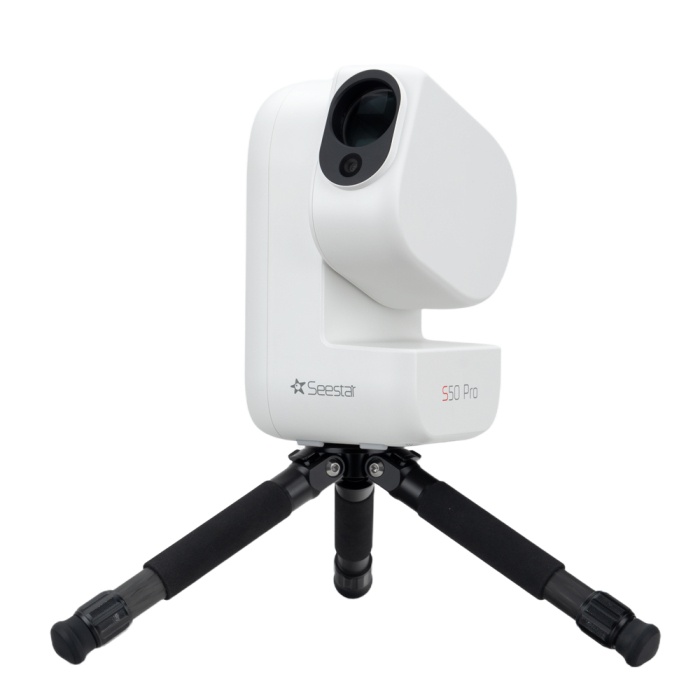
The original Seestar S50 changed the smart-telescope market by delivering an extraordinary amount of automated astrophotography capability for $499. Now Seestar has replaced it with something considerably more ambitious—and considerably more expensive.
The new Seestar S50 Pro costs $999. That’s almost exactly twice what the original S50 cost. But here’s what makes that price increase particularly interesting: the S50 Pro still has a 50mm aperture. Its focal length has increased only slightly, from 250mm to 260mm.
So what exactly are you getting for the additional $500? And if you already own an S50, are those improvements substantial enough to justify upgrading? Those are the questions at the center of this review.
The S50 Pro isn’t simply a larger S50. Instead, Seestar has upgraded almost everything surrounding its 50mm aperture: a much larger main imaging sensor, revised four-element optics, improved tracking hardware, a second ultra-wide camera, twice the storage and a substantially larger battery. Some of those improvements could meaningfully change what you can photograph. Others may matter much less depending on how you use a smart telescope. Let’s find out where that extra $500 actually goes.
Quick Verdict
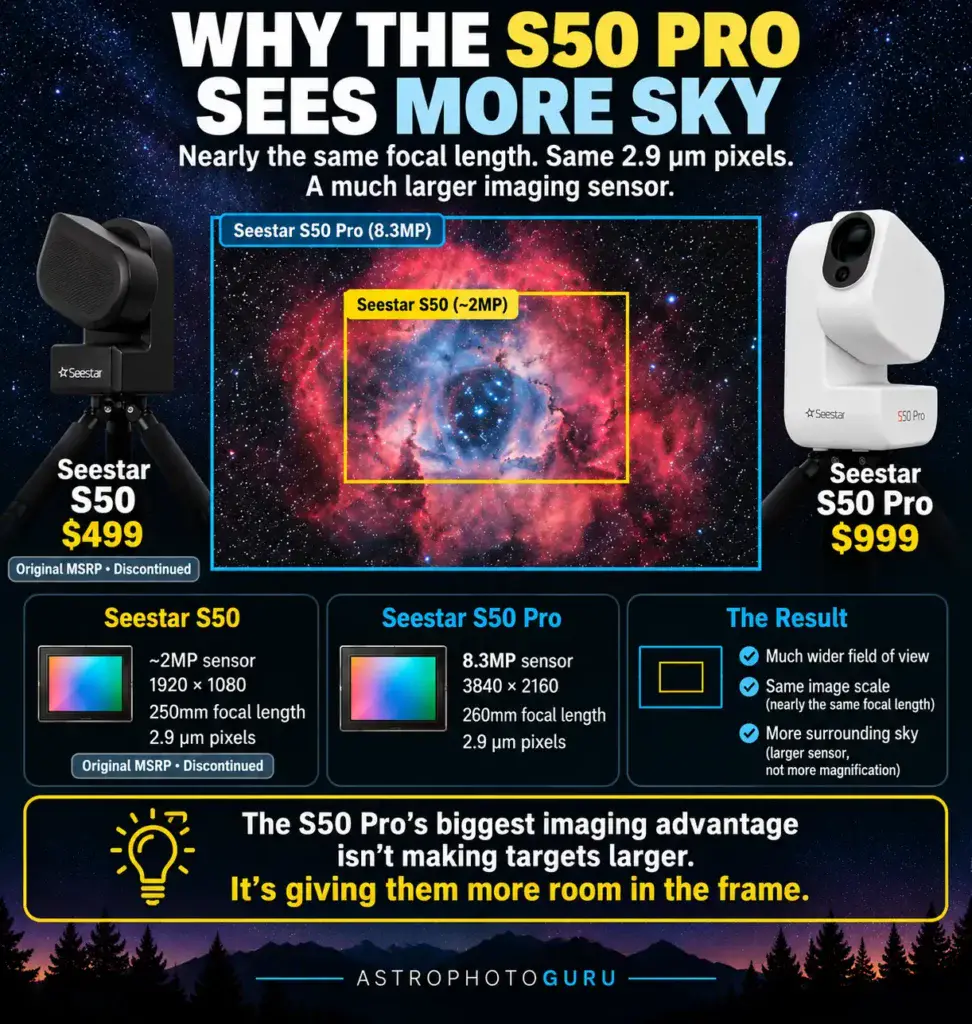
The Seestar S50 Pro is a substantially more capable imaging system than the original S50—but it isn’t twice the telescope. Both have the same 50mm aperture, so the Pro doesn’t suddenly collect twice as much light. Nor does its 260mm focal length transform it into a high-resolution instrument for tiny galaxies and planetary nebulae. Instead, the S50 Pro’s biggest advantage may be something less obvious:
It lets you photograph considerably more sky without substantially changing the image scale.
The original S50 uses a roughly 2-megapixel Sony IMX462 sensor with 2.9-micron pixels. The S50 Pro moves to an 8.3-megapixel OmniVision OS08B10—also with 2.9-micron pixels.Because the Pro has many more pixels across a considerably larger sensor while retaining nearly the same focal length and pixel size, it captures a dramatically larger field without simply making everything smaller to achieve it.
For large nebulae, open clusters and extended galaxies, that’s a major improvement. The Pro also adds an 8.3-megapixel ultra-wide camera for Milky Way imaging, star trails and nightscapes, along with 128GB of storage, a 10,000mAh battery and other optical and mechanical improvements. For existing S50 owners, the upgrade question therefore isn’t simply whether the Pro produces “better pictures.” It’s whether these improvements solve limitations you’ve actually encountered with your S50. And for someone buying their first Seestar today, there’s another question:
Does it make sense to spend $999 on the flagship S50 Pro, or would a less expensive current Seestar such as the S30 Pro provide most of what you actually need?
We’ll address both questions.
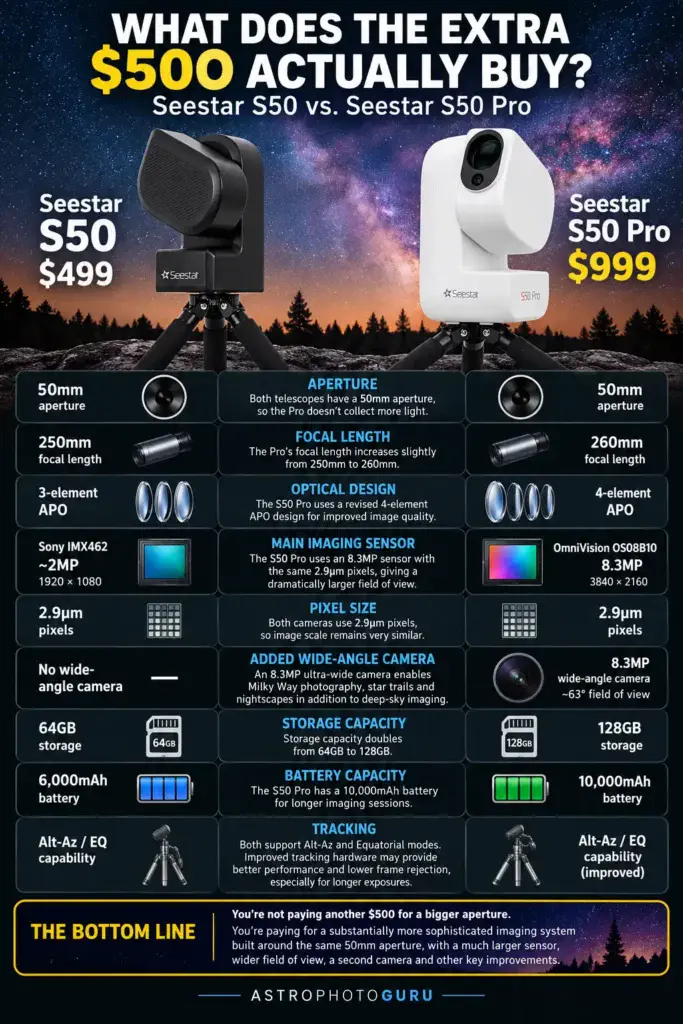
SeeStar S50 vs. SeeStar S50 Pro Specifications
| Specification | Seestar S50 Pro | Original Seestar S50 |
| Aperture | 50mm | 50mm |
| Focal Length | 260mm | 250mm |
| Focal Ratio | f/5.2 | f/5 |
| Optical Design | 4-element APO | 3-element APO |
| Main Camera | OmniVision OS08B10 | Sony IMX462 |
| Main Resolution | 3840 × 2160 / 8.3MP | 1920 × 1080 / approx. 2MP |
| Pixel Size | 2.9 μm | 2.9 μm |
| Wide Camera | 8.3MP | None |
| Wide Camera Field | Approx. 63° | — |
| Storage | 128GB | 64GB |
| Battery | 10,000mAh | 6,000mAh |
| Mount | Alt-Az / EQ capability | Alt-Az / EQ capability |
| Original/List Price | $999 | $499 |
The table reveals something important about the Pro.
You’re not paying another $500 for a bigger telescope. You’re paying for a substantially more sophisticated imaging system built around essentially the same telescope aperture.
What Does the Extra $500 Actually Buy?
Let’s strip away the marketing terminology.
The additional $500 does not buy:
- twice the aperture
- twice the focal length
- twice the light-gathering power
- twice the optical resolution
Instead, it buys improvements primarily in five areas:
1. A dramatically larger main imaging field
2. Four times the main-camera pixel count
3. A completely separate wide-angle imaging system
4. Optical, tracking and mechanical improvements
5. Twice the storage and substantially greater battery capacity
Of those, we think the larger main imaging field deserves particular attention.
The Upgrade You Can Actually See: Field of View
It’s easy to focus on the jump from approximately 2MP to 8.3MP. But megapixels aren’t really the story.
Sensor area is.
The S50 and S50 Pro both use 2.9-micron pixels, while their focal lengths differ by only 10mm. That means their underlying sampling is remarkably similar. The S50 Pro simply gives you far more sensor around the target. And that can completely change the experience of imaging larger deep-sky objects.
Interested in the Seestar S50 Pro?
The S50 Pro makes the most sense for astrophotographers who want the simplicity of a Seestar but would benefit from a substantially wider field of view, higher-resolution sensor and greater imaging flexibility than the original S50.
Check the current Seestar S50 Pro price and availability →
Affiliate disclosure: If you purchase through this link, AstroPhotoGuru may earn a commission at no additional cost to you.
four Targets That Show Why the S50 Pro’s Larger Sensor Matters
Sensor dimensions and field-of-view numbers can be difficult to translate into actual astrophotography. So rather than simply comparing specifications, we used the AstroPhotoGuru Imaging Planner to find targets where the original S50’s relatively narrow field creates a genuine framing limitation—and then compared the same targets with the S50 Pro.
The difference isn’t subtle. The Rosette Nebula, California Nebula, and Triangulum Galaxy all illustrate the same fundamental advantage: the S50 Pro doesn’t substantially magnify these objects more than the S50. Instead, its larger sensor gives them the space needed for a more complete and natural composition. Likewise, although a smaller object like the Whirlpool Galaxy can be completely framed with either, it is just a bit too small to be properly framed with the larger sensor in the S50 Pro.
Triangulum Galaxy- M33
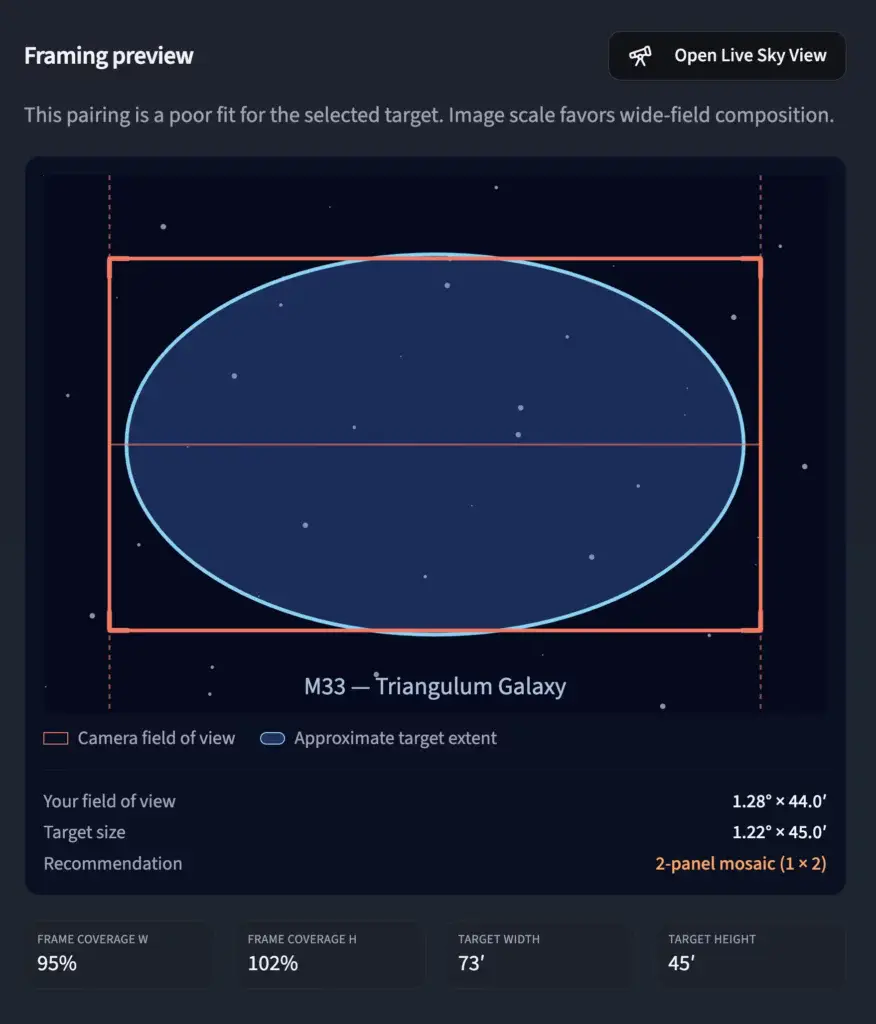
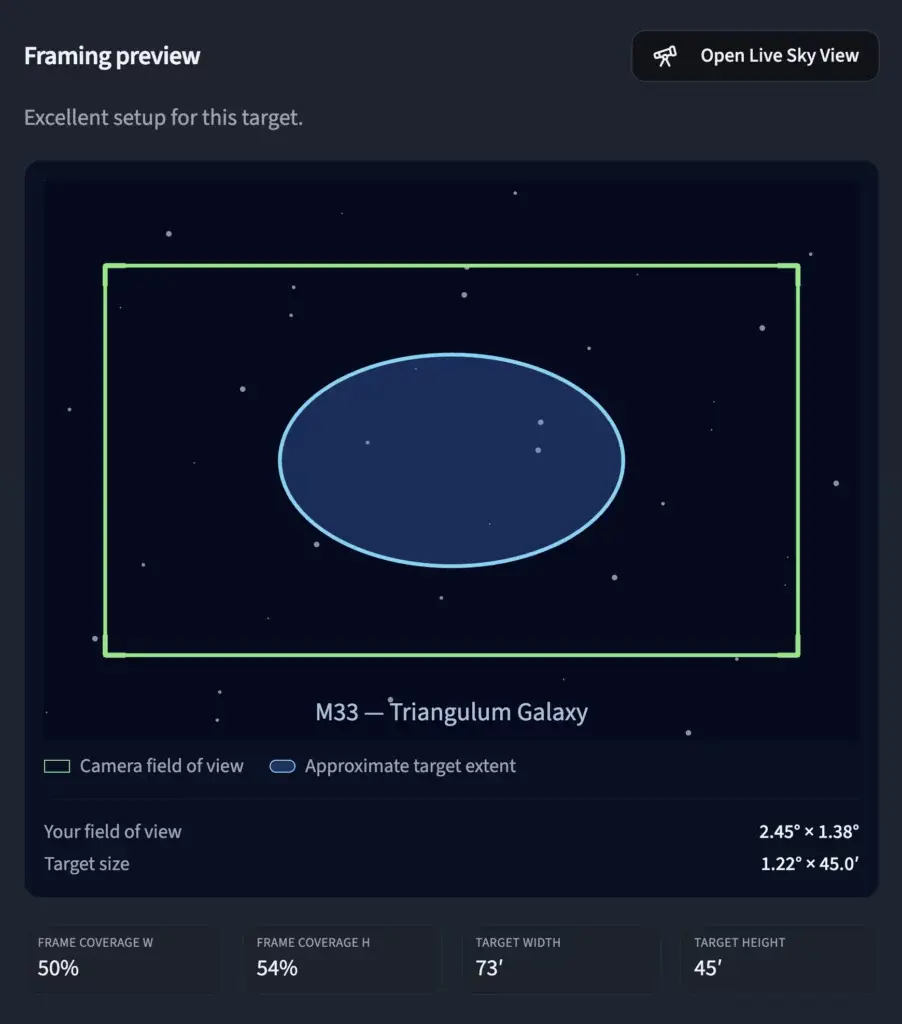
The Triangulum Galaxy is an excellent demonstration of why sensor size matters. The larger sensor in the S50 Pro frames the galaxy perfectly.
Rosette Nebula — NGC 2237/2244
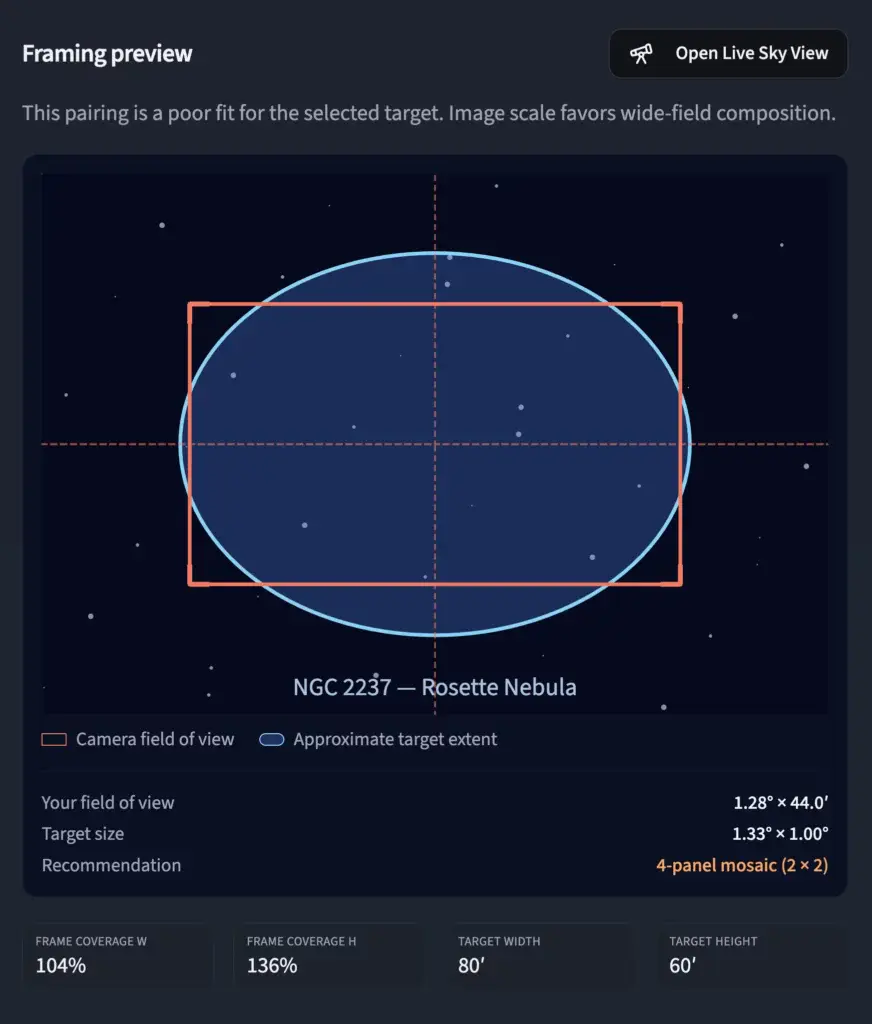
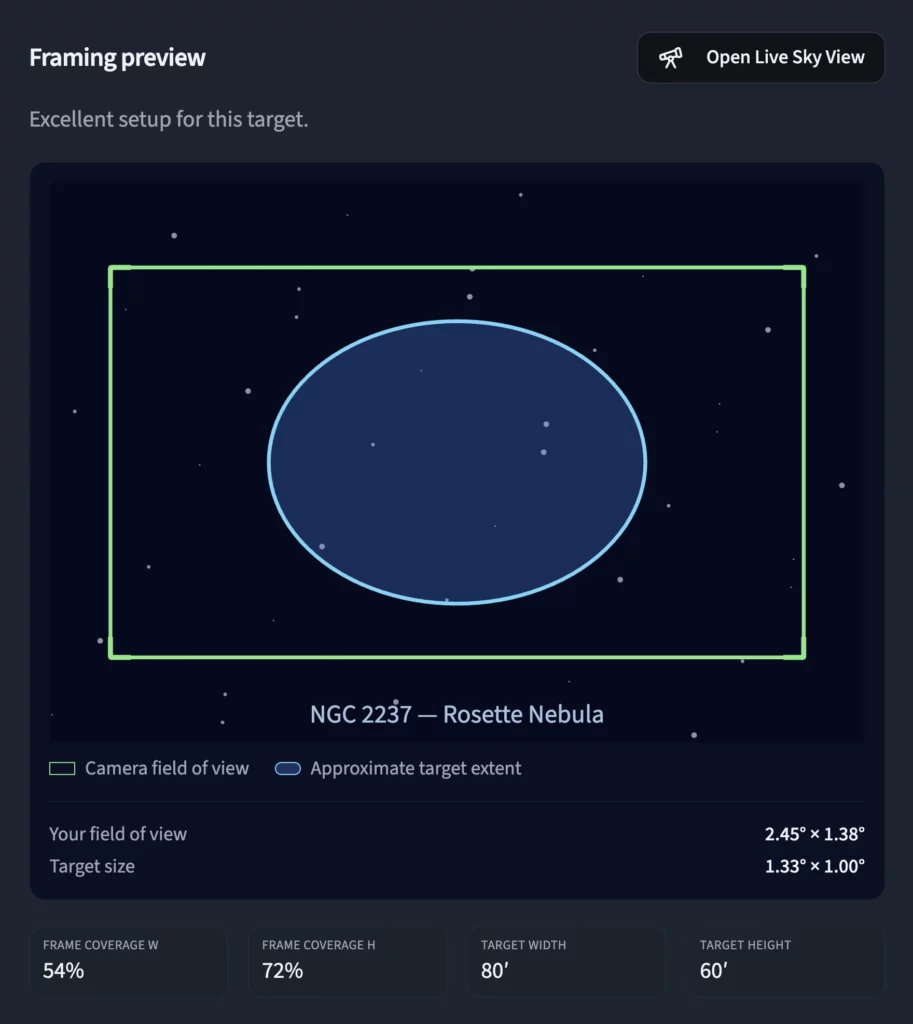
The Rosette is another useful test because it is large enough to expose the original S50’s relatively narrow field as being inadequate to capture the whole target.
california Nebula — NGC 1499
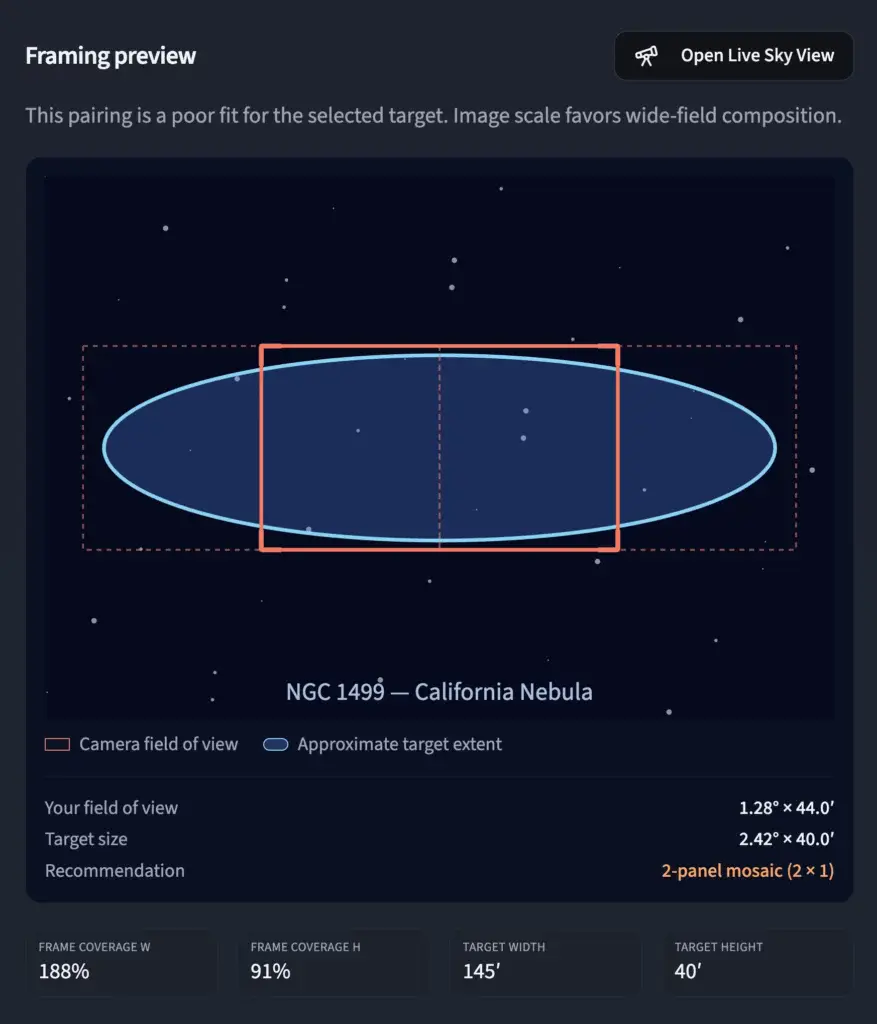
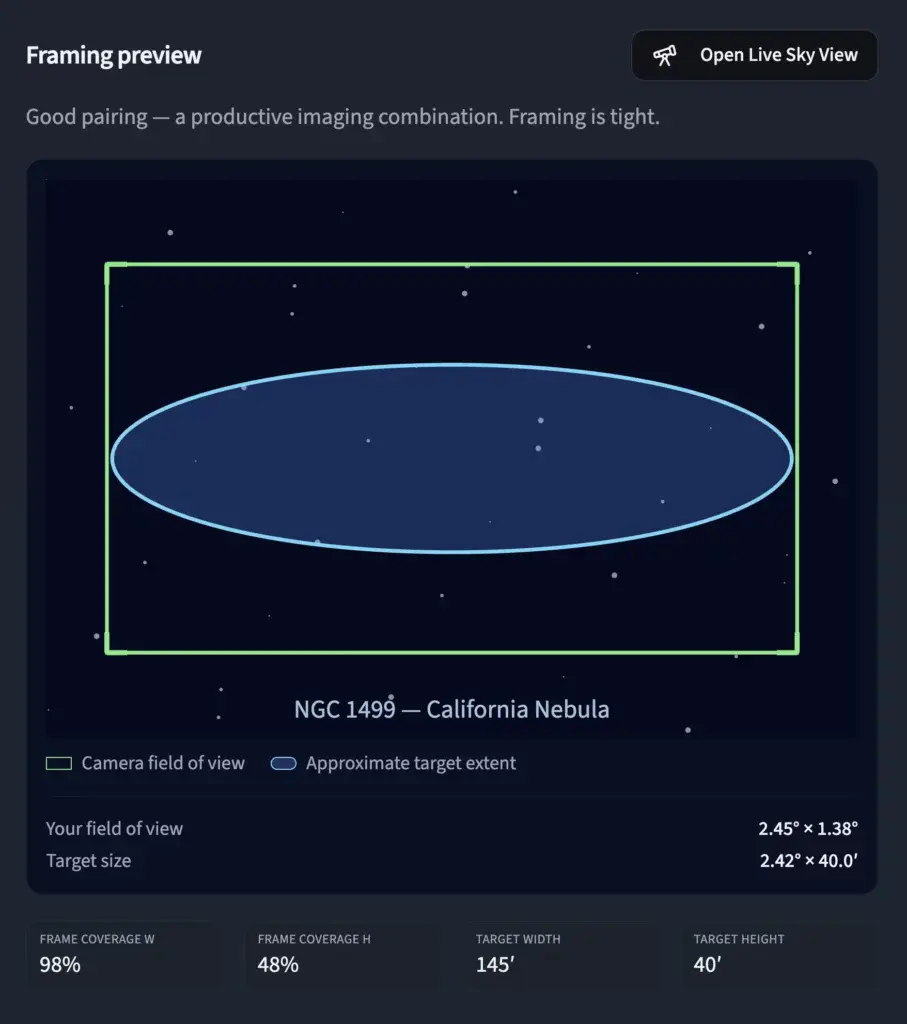
Very large emission nebulae may provide the most dramatic demonstration of the Pro’s advantage.
A Smaller Target
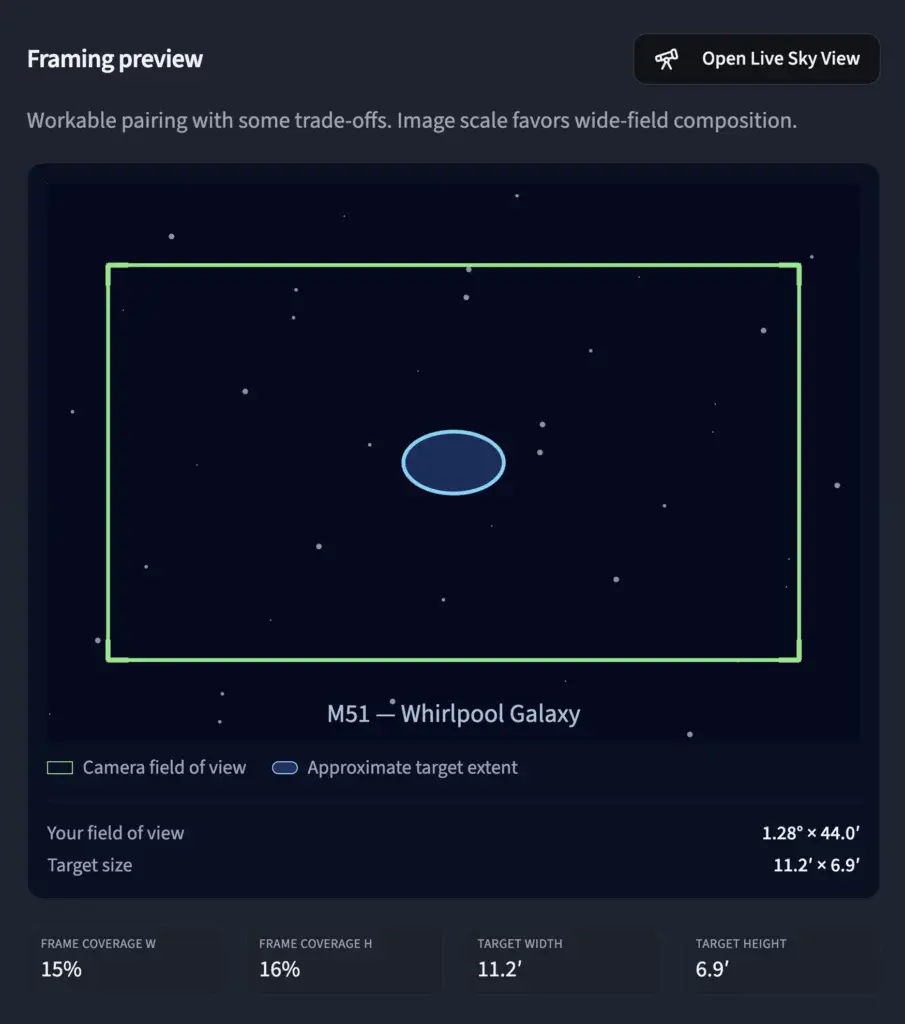
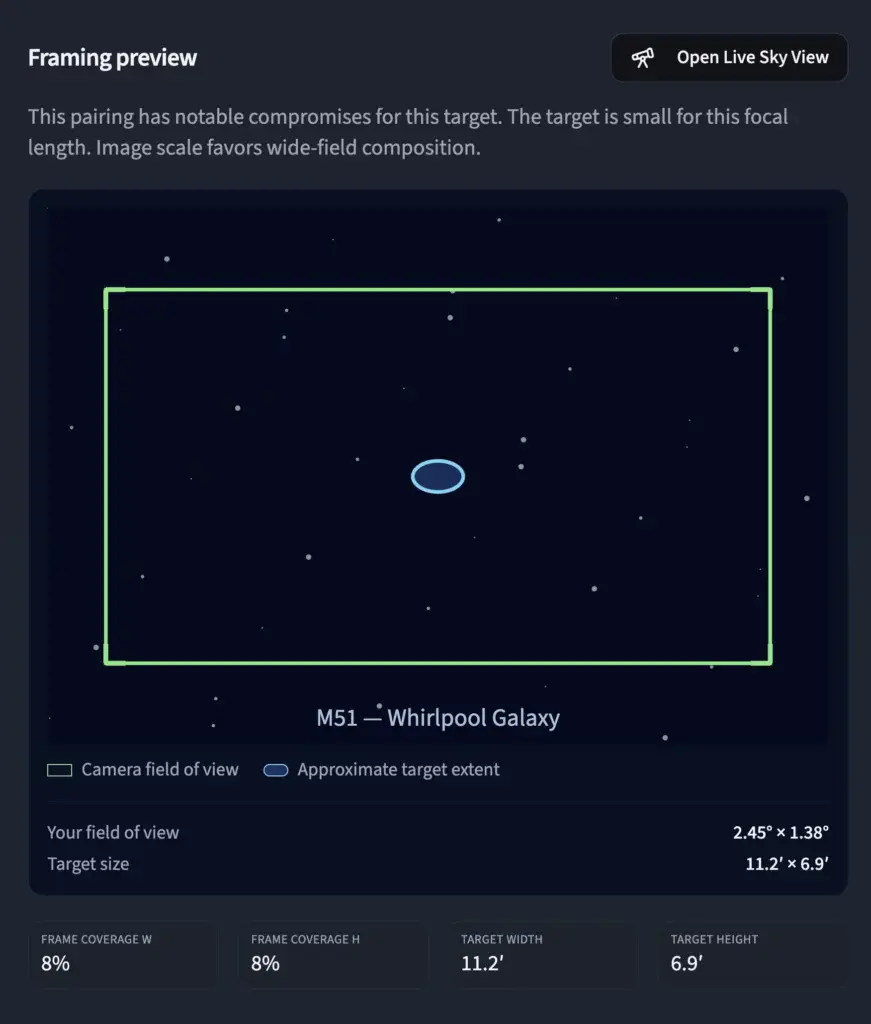
This comparison is equally important. The S50 Pro’s larger sensor does not make every target better. For a small galaxy or planetary nebula, both telescopes place approximately the same number of pixels across the object because their focal lengths and pixel sizes are so similar. The Pro simply records considerably more empty sky around it.
That’s the critical distinction: the S50 Pro dramatically improves framing flexibility, not magnification.
The Sensor Controversy: Is OmniVision Really a Downgrade?
One of the most debated S50 Pro specifications has nothing to do with telescope optics. Seestar chose the OmniVision OS08B10 rather than a Sony IMX585 or another familiar Sony astronomy sensor. For astrophotographers accustomed to seeing Sony sensors inside dedicated astronomy cameras, that immediately raised questions. But dismissing the OS08B10 simply because it says OmniVision rather than Sony would be a mistake. The 8.3MP sensor has 2.9-micron pixels and some particularly interesting characteristics for short-exposure computational astrophotography.
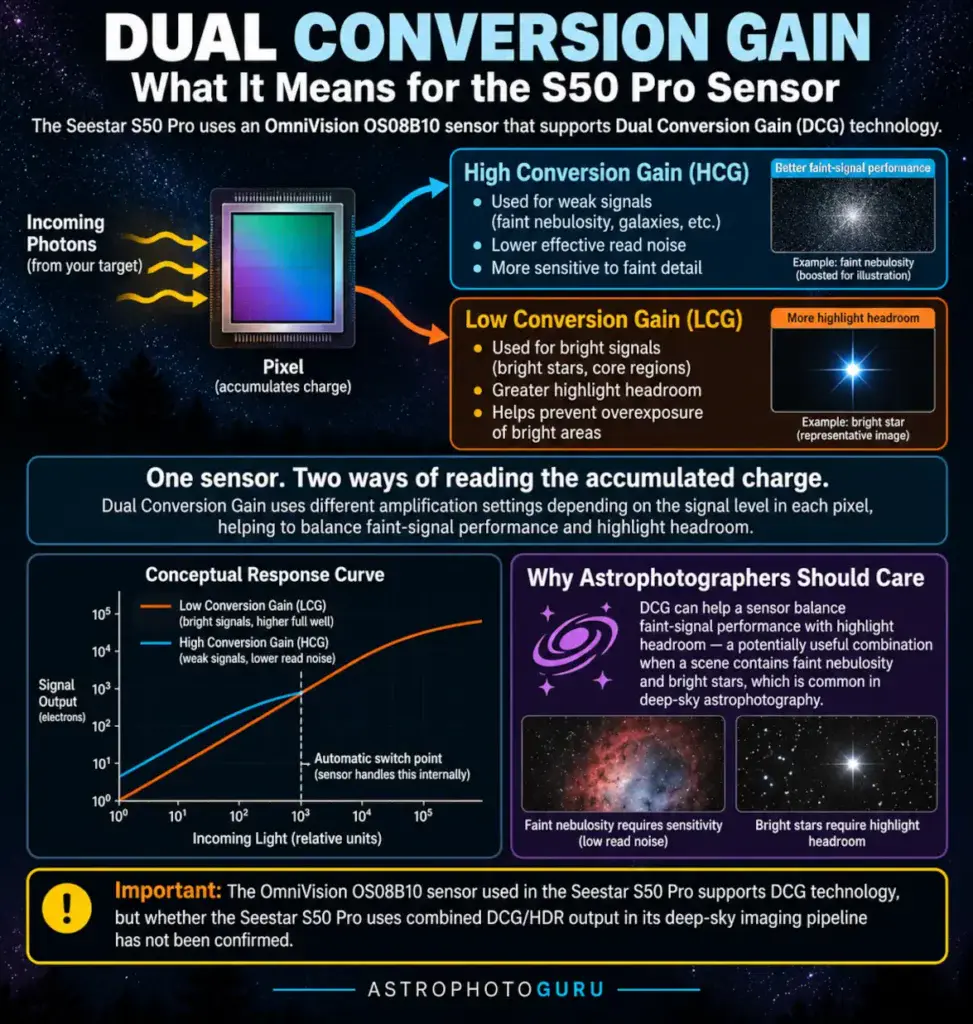
Dual Conversion Gain Could Be Particularly Interesting
One overlooked capability of the OS08B10 is OmniVision’s Dual Conversion Gain, or DCG, architecture. At a simplified level, high conversion gain is useful when signals are weak because small amounts of collected charge produce a larger voltage response, helping minimize the significance of read noise. Low conversion gain provides greater headroom for stronger signals before saturation.
Astrophotography routinely presents both situations in the same frame: extremely faint nebulosity surrounding much brighter stars. The OS08B10 can obtain high- and low-conversion-gain information from accumulated pixel charge and supports on-chip DCG combination. In principle, that makes DCG particularly interesting for high-dynamic-range astronomical scenes.
There is an important caveat.
The OS08B10 supports DCG, but we have not yet confirmed that the S50 Pro uses the sensor’s combined DCG/HDR output in its deep-sky imaging pipeline.
So DCG should currently be considered an intriguing sensor capability rather than a proven S50 Pro advantage.
What About Read Noise?
Independent sensor measurements have also produced encouraging results, particularly in the higher-gain regime, where measured read noise becomes very low. There is a tradeoff. The OS08B10 doesn’t offer the same full-well capacity as some competing Sony sensors, potentially allowing bright stars and bright portions of targets to saturate sooner.
But smart telescopes operate differently from many conventional astrophotography systems. Instead of relying primarily on very long individual exposures, they collect large numbers of relatively short subexposures and stack them computationally. That may make the balance between low read noise and full-well capacity particularly appropriate for the S50 Pro.
The relevant question therefore isn’t:
Is OmniVision better than Sony?
It’s:
Did Seestar choose the right sensor for the way the S50 Pro actually captures images?
Early results suggest the answer may be more interesting than the sensor’s brand name implies.
A Second Camera Changes the S50 Concept
The S50 Pro isn’t merely a one-camera telescope.
Alongside the 260mm telephoto system is an 8.3MP ultra-wide camera covering approximately 63 degrees of sky.
That enables:
- Milky Way photography
- constellation imaging
- star trails
- nightscapes
- extremely wide regions of sky
The original S50 couldn’t realistically perform these jobs through its narrow main camera.
That means the Pro is beginning to look less like simply an upgraded smart telescope and more like a two-focal-length computational astrophotography system. Whether that’s worth paying for depends on whether you’ll actually use it. If your interests are almost entirely galaxies and smaller deep-sky objects, the wide camera may have limited value. If you want one highly portable device capable of moving from telescopic deep-sky imaging to Milky Way photography, it could be one of the S50 Pro’s strongest features.
Better Tracking Could Matter More Than More Megapixels
Tracking doesn’t make an exciting specification-sheet headline, but it directly affects image quality. Smart telescopes create their final images by stacking many individual exposures. Every subexposure rejected because of tracking error represents imaging time that contributes nothing to the final result. Early testing of the S50 Pro has reported encouraging tracking performance and lower frame-rejection rates, including with longer subexposures.
We want to see broader independent testing before drawing strong conclusions about exactly how large that improvement is. But if the S50 Pro can consistently retain substantially more 20-, 30- or 60-second exposures than the original S50, the improvement could ultimately matter more than the jump from 2MP to 8.3MP.
EQ Mode: From Smart Telescope Toward Serious Astrophotography
Equatorial operation addresses one of the fundamental limitations of an alt-azimuth smart telescope: field rotation. In normal alt-az mode, the telescope can keep an object centered, but the orientation of the surrounding star field gradually rotates. Over long integrations, this requires increasingly aggressive cropping of the stacked image.
EQ operation largely eliminates that problem and makes longer subexposures and integrations more practical. For casual use, alt-az mode retains the Seestar’s greatest advantage:
Set it down and start imaging.
But users interested in extracting the best possible data from the S50 Pro may find EQ operation increasingly attractive. This also illustrates how the S50 Pro is moving beyond the original S50’s role as an exceptionally simple entry point into astrophotography.
More Battery and Storage
The S50 Pro doubles internal storage from 64GB to 128GB and increases battery capacity from 6,000mAh to 10,000mAh. Neither improvement justifies an additional $500 by itself. But both make sense.
Higher-resolution imaging creates larger files. A second camera creates additional data. Longer EQ imaging sessions consume more power. These upgrades support what the S50 Pro is intended to become: a more capable imaging platform rather than simply a refreshed S50.
The Limitation That Hasn’t Changed: 50mm Is Still 50mm
This is perhaps the most important reality check in the entire review. The S50 Pro still has a 50mm aperture. Its 260mm focal length is also very close to the original S50’s 250mm. So don’t expect the Pro to suddenly transform small galaxies or tiny planetary nebulae. Consider a target such as the Whirlpool Galaxy.
Because the two Seestars have nearly identical focal lengths and identical pixel sizes, M51 occupies approximately the same number of pixels on both sensors. The Pro gives you a much larger canvas around it. It doesn’t substantially enlarge the galaxy itself. In fact, it appears smaller in the Pro.
That makes the S50 Pro particularly compelling for larger targets—but potentially much less transformative for S50 owners whose interests center on small galaxies.
Should Existing S50 Owners Upgrade?
This may be the most important buying question surrounding the S50 Pro. The original S50 has been discontinued, so these aren’t simply two current products sitting next to each other on a store shelf. Instead, millions of dollars’ worth of perfectly functional S50s are already in owners’ hands.
For those owners, the question becomes:
Does the S50 Pro fix something about your S50 that actually bothers you?
Consider upgrading if you frequently find yourself wishing for:
- substantially wider framing
- more room around large nebulae and galaxies
- higher-resolution source images
- improved tracking for more ambitious imaging
- serious EQ-mode use
- Milky Way and nightscape capability
- more storage and longer battery life
Keeping your S50 may make considerably more sense if:
- you’re happy with its existing field of view
- you primarily image smaller targets
- you value simplicity over more advanced imaging options
- you don’t expect to use the wide camera
- you’re satisfied with your current stacked images
The S50 Pro is unquestionably more capable. That doesn’t automatically make an S50 obsolete.
What About Someone Buying Their First Seestar?
The decision is quite different for a new buyer because the original S50 is no longer the obvious $499 alternative. Now the question becomes whether to buy the flagship S50 Pro or choose one of Seestar’s less expensive current models, particularly something like the S30 Pro. That deserves its own detailed comparison.
But the basic decision is straightforward:
The S50 Pro should appeal most strongly to buyers who already know they value its 50mm aperture, substantially larger main imaging field, higher-resolution sensor, wide camera and more ambitious imaging capabilities. A less expensive Seestar may make more sense for someone primarily attracted by the simplicity and automation that made the original S50 successful in the first place.
At $999, the Competition Changes
There’s another consequence of doubling the price. At $499, the original S50 could almost be considered an impulse purchase by astrophotography standards. At $999, expectations change.
The S50 Pro now competes not only with other smart telescopes but with increasingly capable conventional astrophotography equipment. That makes automation part of the value proposition. The S50 Pro combines a telescope, two cameras, computerized mount, autofocus, filters, plate solving, tracking, stacking and processing into one highly portable device.
Building an equivalent conventional system isn’t necessarily cheaper—and certainly isn’t as simple. But experienced astrophotographers who already own mounts, telescopes and cooled astronomy cameras may reasonably conclude that another $999 would produce greater benefits elsewhere in their existing system. That’s why the S50 Pro’s value cannot be judged by specifications alone.
Is the Seestar S50 Pro Really Worth Twice What the S50 Cost?
The original S50 established an extraordinarily high bar for value. For $499, it gave thousands of people an easy path into electronically assisted observing and astrophotography without requiring them to understand polar alignment, guiding, plate solving, autofocus routines or image stacking before capturing their first deep-sky object.
The S50 Pro costs almost exactly twice as much. But it isn’t trying to provide twice the telescope. Instead, it addresses many of the limitations that more experienced S50 users eventually encounter. The substantially larger main sensor provides much greater framing flexibility without sacrificing much image scale. Improved tracking and more ambitious EQ operation may produce more usable data. The second camera opens an entirely different category of wide-field imaging. And additional storage and battery capacity support longer and more demanding sessions.
For an existing S50 owner, that doesn’t automatically justify spending $999. If the S50 already frames the targets you enjoy and produces images you’re happy with, the strongest argument may be to keep using it.
But if you’ve repeatedly run into the edges of the S50’s sensor, want to push into longer EQ integrations, or want a single portable system capable of both telescopic and wide-field astrophotography, the Pro addresses real limitations rather than simply adding cosmetic upgrades.
And that may ultimately be the fairest description of the S50 Pro:
Considering the Seestar S50 Pro?
If the S50 Pro’s wider field of view, larger sensor and all-in-one convenience match the kind of astrophotography you want to do, you can check the latest pricing and availability below.
It’s not twice the telescope the S50 was.
But for the right astrophotographer, it could provide considerably more than twice the imaging flexibility.

