In astrophotography, sensor size directly impacts image framing, and appear in the image, particularly when photographing celestial bodies, such as planets, stars, and nebulae. Let’s break down how these principles apply specifically to astrophotography.
1. Field of View (FOV) and Framing Celestial Objects
- Larger Sensors: Full-frame sensors (36 x 24 mm) have a wider field of view, which allows for a broader area of the sky to be captured. This is useful for wide-field astrophotography, such as capturing the Milky Way or large nebulae, as it provides more context and captures more stars and celestial features in one shot.
- Smaller Sensors: A smaller sensor does not increase the telescope’s optical magnification or change its image scale. Instead, it records a smaller portion of the same image projected by the telescope, producing a narrower field of view. The target therefore occupies a larger percentage of the final frame, which can look like extra “reach” when images are displayed at the same size. You can see this directly in the AstroPhotoGuru Imaging Planner by keeping the telescope fixed and switching between full-frame, APS-C, and smaller sensors.
- What is the Crop Factor? The crop factor, also called focal length multiplier refers to the effective “magnification” of the image compared to a full-frame sensor. The image is not really magnified given the same lens or telescope, but it appears to be larger due to it filling more of the frame.
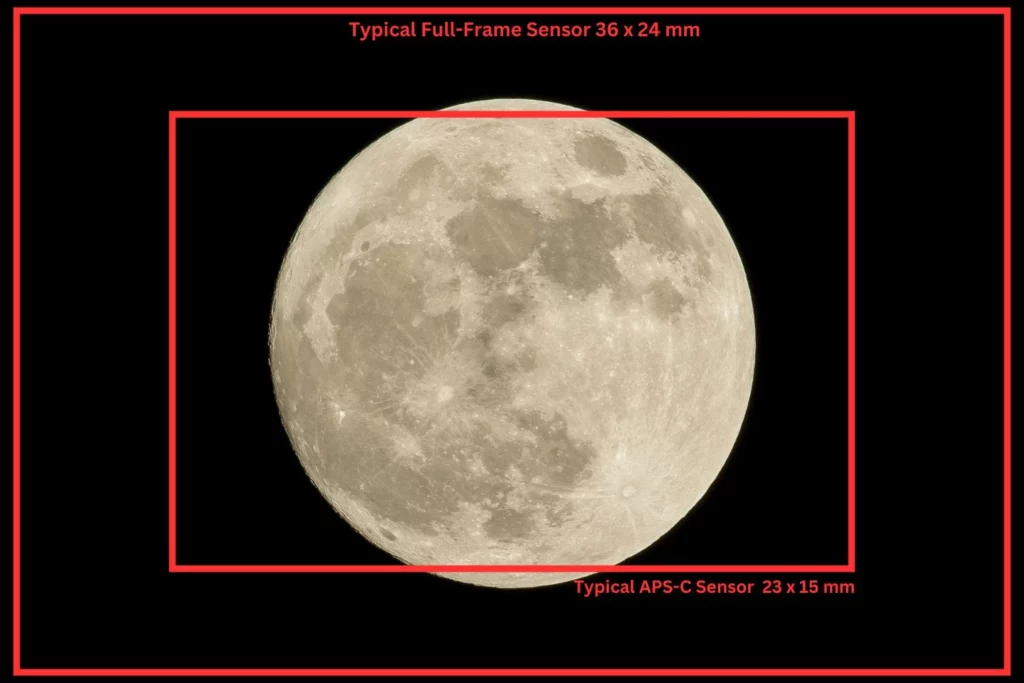
For example, a 1000mm telescope on an APS-C sensor (1.5x crop) effectively frames the sky like a 1500mm focal length on a full-frame sensor, which can bring distant celestial objects closer, helping fill the frame with more detail. In the image below, the moon is the same size, but it fills more of the frame of the APS-C sensor, so it appears larger, or magnified.
2. Magnification Effect for Distant Celestial Objects
- Smaller sensors create a “magnification” effect, which is especially useful in astrophotography where reaching the desired level of detail requires longer focal lengths. For example:
- Shooting the Moon with a smaller sensor will make it appear larger in the frame compared to a full-frame sensor, making it easier to capture detailed lunar features without excessive cropping in post-processing.
- For planetary astrophotography, a smaller sensor paired with a long focal-length telescope allows you to fill the frame with planets like Jupiter or Saturn, helping capture more intricate details such as cloud bands or ring structures.
3. Image Framing with Telescope Focal Lengths and Different Sensors
- Larger sensors can capture a broader portion of the sky in a single frame, making them suitable for deep-sky astrophotography of larger nebulae, star fields, and wide Milky Way shots. For example, a full-frame sensor attached to a wide-field telescope might be able to capture the entire Andromeda Galaxy.
- Smaller sensors provide a more zoomed-in perspective for a given telescope, framing smaller objects in a way that emphasizes details. This is particularly valuable for galaxies, globular clusters, or specific features on the Moon’s surface. However, it does limit the field of view, which can be restrictive for capturing large regions of space.
ASTROPHOTOGURU TIP — SENSOR SIZE DOESN’T CHANGE MAGNIFICATION Moving from full frame to APS-C or a smaller sensor gives you a narrower field of view, but it does not increase the telescope’s focal length, optical magnification, or image scale. The smaller sensor simply records a smaller portion of the same image projected by the telescope, so the target occupies a larger percentage of the final frame. You can see this directly in the AstroPhotoGuru Imaging Planner by keeping the telescope fixed and switching between different camera sensor sizes.
4. Sensor Size and Signal-to-Noise Ratio
- Larger sensors generally have larger individual pixels (assuming similar resolution), which can capture more light per pixel. This is beneficial in low-light conditions, such as astrophotography, where light is minimal. Larger pixels produce a higher signal-to-noise ratio, resulting in cleaner images with less noise.
- Smaller sensors with smaller pixels may suffer from higher noise levels, especially in low-light astrophotography. To compensate, one might need to use stacking techniques or dark frames to reduce noise.
5. Practical Impact on Different Types of Astrophotography
- Wide-Field Astrophotography: For capturing expansive views of the Milky Way or large nebulae, a full-frame sensor (preferably) or larger APS-C is often ideal. It allows you to capture the entire scene with a single shot, providing more image framing flexibility. If you pair this with a short focal length lens or telescope, very wide fields are possible.
- Deep-Sky Object (DSO) Imaging: Smaller sensors can be advantageous here because their crop factor can help focus on smaller objects, like individual galaxies, planetary nebulae, or globular clusters, filling the frame without needing a larger telescope or additional magnification tools, like a Barlow lens or longer focal length lenses or telescopes.
- Planetary Imaging: Smaller sensors are preferred here, as they allow for a more magnified view of planets without requiring an excessively long focal length. A smaller sensor can bring planets closer in-frame, allowing you to capture more detail in the planetary surface features, such as the bands of Jupiter or the rings of Saturn. When you pair this with video capture, hundreds or thousands of stacked images can really enhance the quality of the final image, revealing considerable detail.
Example in Practice:
Imagine you’re using a telescope with a 1000mm focal length and two different cameras:
- Full-Frame Camera: The field of view will be wider, making it easier to capture larger objects or surrounding stars, though the primary object may appear smaller within that frame. This scenario is ideal for expansive Milky Way images (with or without landscape features) or large nebulae.
- APS-C Camera (1.5x crop factor): The same telescope and camera setup will create a narrower field of view, effectively making the object appear larger (by an order of the crop factor) in the frame without changing the telescope’s physical magnification.
- For help choosing which is best, check out our guide.
NEXT STEP — CHOOSE A TARGET, NOT JUST A FIELD OF VIEW Field-of-view numbers become much easier to interpret when you compare them with a real object. Our Top 10 Deep-Sky Astrophotography Objects guide provides a useful set of targets with very different angular sizes, while the Galaxy Season guide is a better next step when you are working at moderate or long focal lengths and want smaller spring targets.
In summary:
- Larger Sensors are ideal for capturing wide-field shots of large celestial features and backgrounds. They also tend to have larger pixels, which gather more light quickly.
- Smaller Sensors are beneficial for framing smaller objects more closely, as they add a natural crop factor to the field of view, creating a “zoomed-in” effect that can be useful for deep-sky and planetary imaging.
Ultimately, the choice of sensor size depends on the type of astrophotography you’re pursuing, with larger sensors offering broad context and smaller sensors providing effective “magnification” for distant or smaller targets. Image framing is one of the most important factors. Of course, this applies to all types of photography. Most astrophotographers use multiple tools to achieve the perfect framing for the wide variety of celestial objects.


Excellent article very easy to understand.
Thanks..hope it helped!