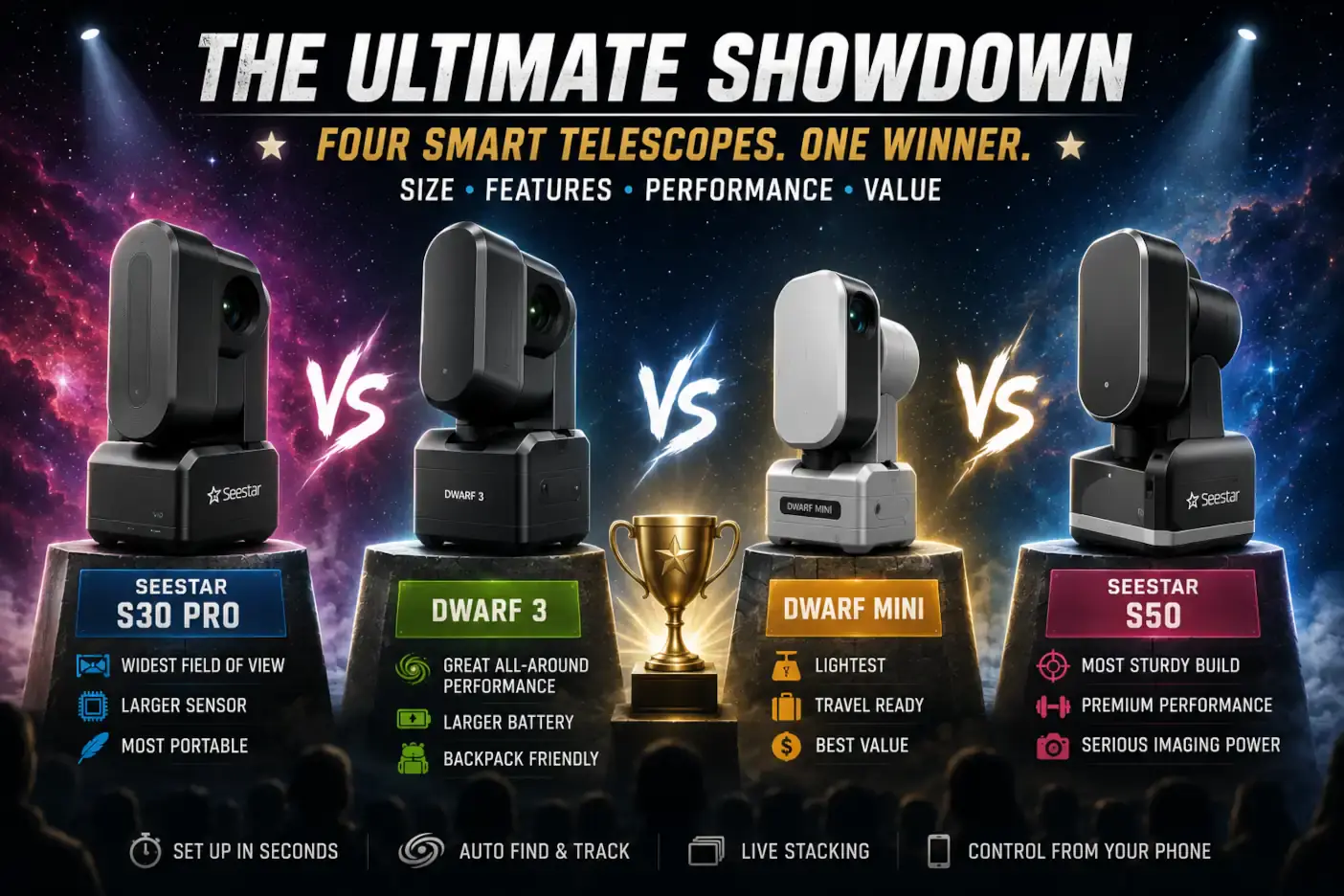
DWARF 3 vs DWARF Mini vs Seestar S30 Pro vs S50: Which Is Best for You?
Smart telescopes have changed the entry point into astrophotography. Instead of assembling a telescope, mount, astronomy camera, computer, power system and other accessories, you can now place a compact all-in-one system outside, connect with a phone or tablet, select a target and begin imaging. But choosing between today’s smart telescopes isn’t as simple as comparing aperture or camera resolution. The DWARF 3, DWARF Mini, Seestar S30 Pro and Seestar S50 have noticeably different optical and imaging characteristics. Aperture matters, but so do focal length, sensor size, pixel size, field of view, portability and features. Those differences become easier to understand when you stop looking only at specifications and ask a more practical question:
How will each telescope actually frame the objects I want to photograph? That’s especially important with these four models. The Seestar S50 has the largest aperture and longest focal length, while the Seestar S30 Pro combines one of the shortest focal lengths with the largest imaging sensor in the group.
The result is two very different approaches to imaging. The S30 Pro covers a larger area of sky in a single frame. The S50 provides a narrower field that can give smaller targets more scale in the image. So rather than declaring one telescope the winner based on a single specification, let’s compare them according to the kinds of objects you actually want to image. And where field of view makes an important difference, I’ll include links to the AstroPhotoGuru Imaging Planner so you can open the telescope and target together and see the calculated framing for yourself. These specifications are based on manufacturer information current when this comparison was prepared.
NEW TO SMART TELESCOPES? If you are still deciding whether an all-in-one telescope is the right approach—not merely which of these four models to buy—start with our guide to choosing a smart telescope. It explains the category and the tradeoff between an integrated automated system and assembling a conventional astrophotography rig.
DWARF 3 vs DWARF Mini vs Seestar S30 Pro vs S50: Key Specifications
| Specification | Dwarf 3 | Dwarf Mini | SeeStar S30 Pro | SeeStar S50 |
| Aperture | 35mm | 30mm | 30mm | 50mm |
| Focal Length | 150 mm | 150 mm | 160 mm | 250 mm |
| Focal Ratio | f/4.3 | f/5.0 | f/5.3 | f/5.0 |
| Main Sensor | Sony IMX678 Starvis 2 | Sony IMX662 | Sony IMX585 | Sony IMX462 |
| Sensor Format | 1/1.8" | 1/2.8" | 1/1.2" | 1/2.8" |
| Pixel Size | 2 µm | 2.9 µm | 2.9 µm | 2.9 µm |
| Max Resolution | 3840 x 2160 | 1920 x 1080 | 3840 x 2160 | 1920 x 1080 |
| Equatorial Mode | yes | yes | yes | yes |
| Weight | 1.35 kg | 0.84 kg | 1.65 kg | 2.5 kg |
| Battery | 10000 mAh | 7000 mAh | 6000 mAh | 6000 mAh |
| Storage | 128 GB | 64 GB | 128 GB | 64 GB |
| Wide-angle Camera | yes | yes | yes | yes |
| Current List Price* | $549 | $419 | $699 | $499 |
*Prices are those recorded from the manufacturers when this article was prepared and are subject to change.
Why Aperture Doesn’t Tell the Whole Story
It would be easy to look at the 50 mm aperture of the Seestar S50 and conclude that it must be the most capable telescope in this group.
For some targets, its larger aperture and 250 mm focal length are genuine advantages. But astrophotography is also about how much sky reaches the sensor, and that depends heavily on both focal length and the physical dimensions of the imaging sensor.
This is where the Seestar S30 Pro becomes particularly interesting. Its aperture is only 30 mm, but its IMX585 is the largest main imaging sensor in this comparison. Pair that larger sensor with a relatively short 160 mm focal length and the S30 Pro captures a considerably larger patch of sky in a single frame.
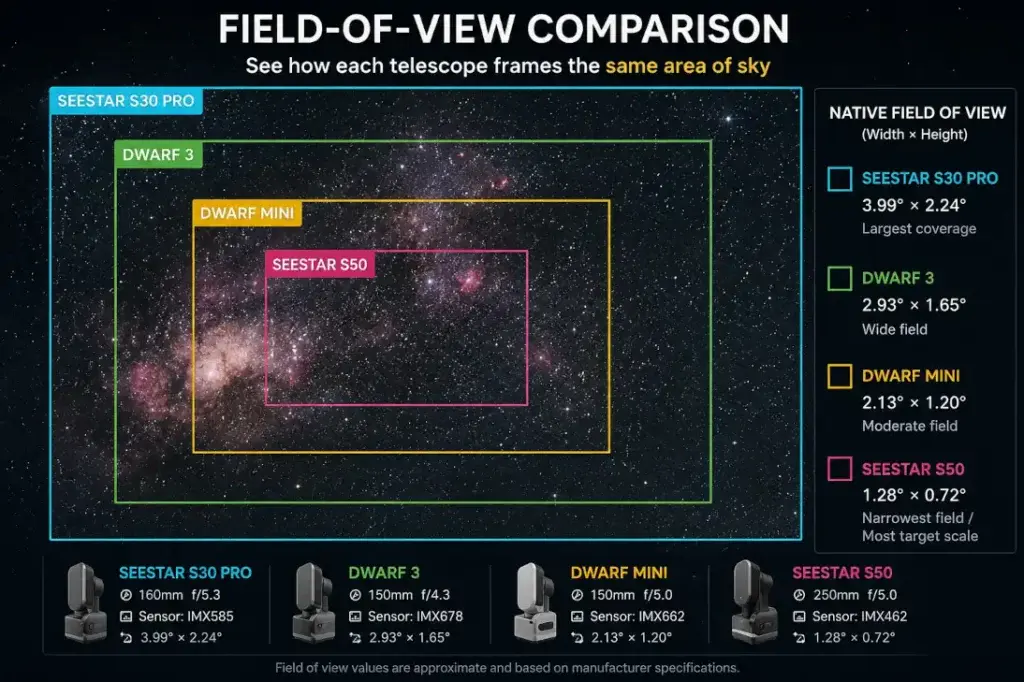
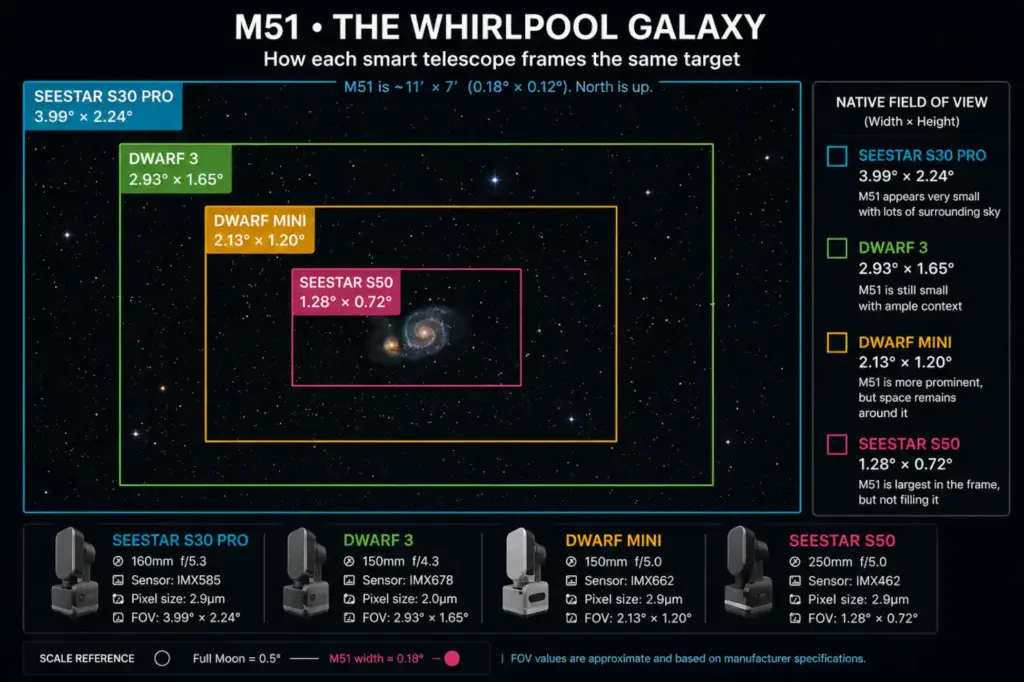
Using the manufacturers’ published resolution and pixel-size specifications, we can calculate approximate native fields of view:
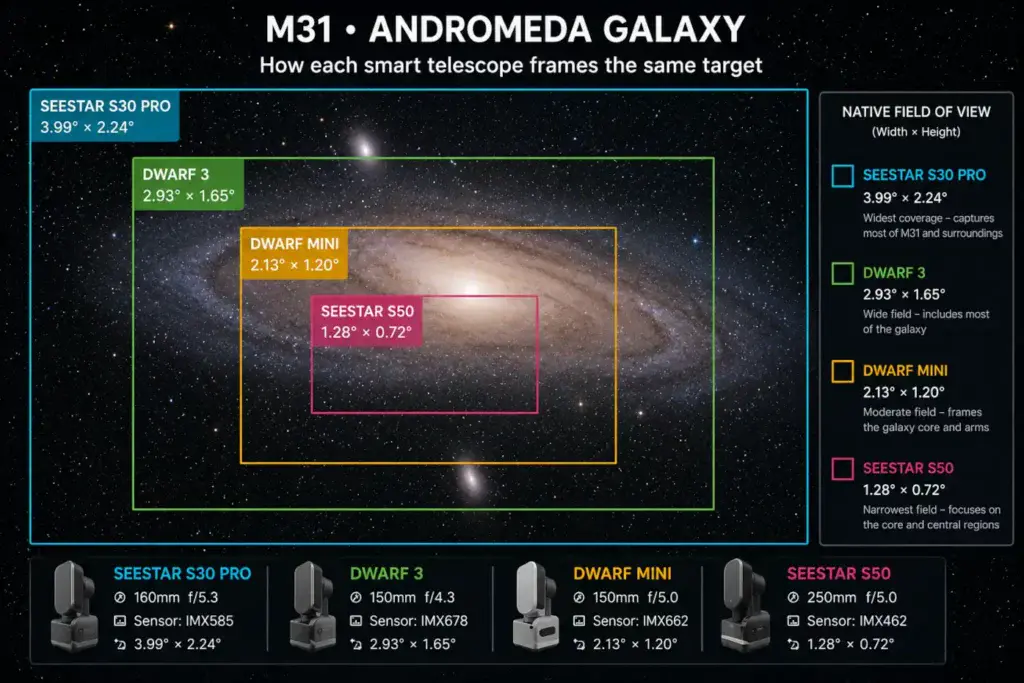
- Seestar S30 Pro: 3.99° × 2.24°
- DWARF 3: 2.93° × 1.65°
- DWARF Mini: 2.13° × 1.20°
- Seestar S50: 1.28° × 0.72°
That’s a substantial difference. The S30 Pro covers roughly three times the angular width of the S50’s frame. For large nebulae, very large galaxies and broad regions of the Milky Way, that can have a greater effect on composition than aperture alone. The flip side is that the S50’s narrower field puts a small target across more of the frame.
In simplified terms:
- S30 Pro: more sky in one frame.
- S50: more image scale for smaller objects.
Check Current Availability:
- Dwarf 3➜ Check current pricing
- Dwarf Mini➜ Check current pricing
- Seestar S30 Pro➜ Check current pricing
- Seestar S50 Discontinued
Neither is automatically better. The target matters.
Large Nebulae: The North America Nebula
The North America Nebula (NGC 7000) is a good demonstration because it covers a large area of sky. This is exactly the kind of target where the S30 Pro’s combination of a larger sensor and 160 mm focal length becomes useful. Its wider native field captures considerably more of the nebula and surrounding Cygnus star field in each frame. The S50 can certainly image NGC 7000, but its narrower field means that capturing a broad composition requires more reliance on mosaicking. And that matters even though all four telescopes support mosaics. Mosaics are a powerful way to overcome a telescope’s native field-of-view limitation, but they aren’t free. More panels generally mean more total acquisition time, additional overlap, and more opportunities for changing conditions between panels. Consequently, a telescope that can cover a large target with fewer panels has a practical advantage.
PUT IT INTO PRACTICE — COMPARE THE SAME TARGET BEFORE YOU BUY The North America Nebula is a useful example because the target is large enough that field of view becomes a major buying consideration. A wider smart telescope can preserve more of the surrounding nebula in a single frame, while a narrower field may be preferable for smaller targets. Use the AstroPhotoGuru Imaging Planner to compare a target against different telescope/camera combinations rather than choosing from aperture or focal length alone.
See the Difference in the Imaging Planner
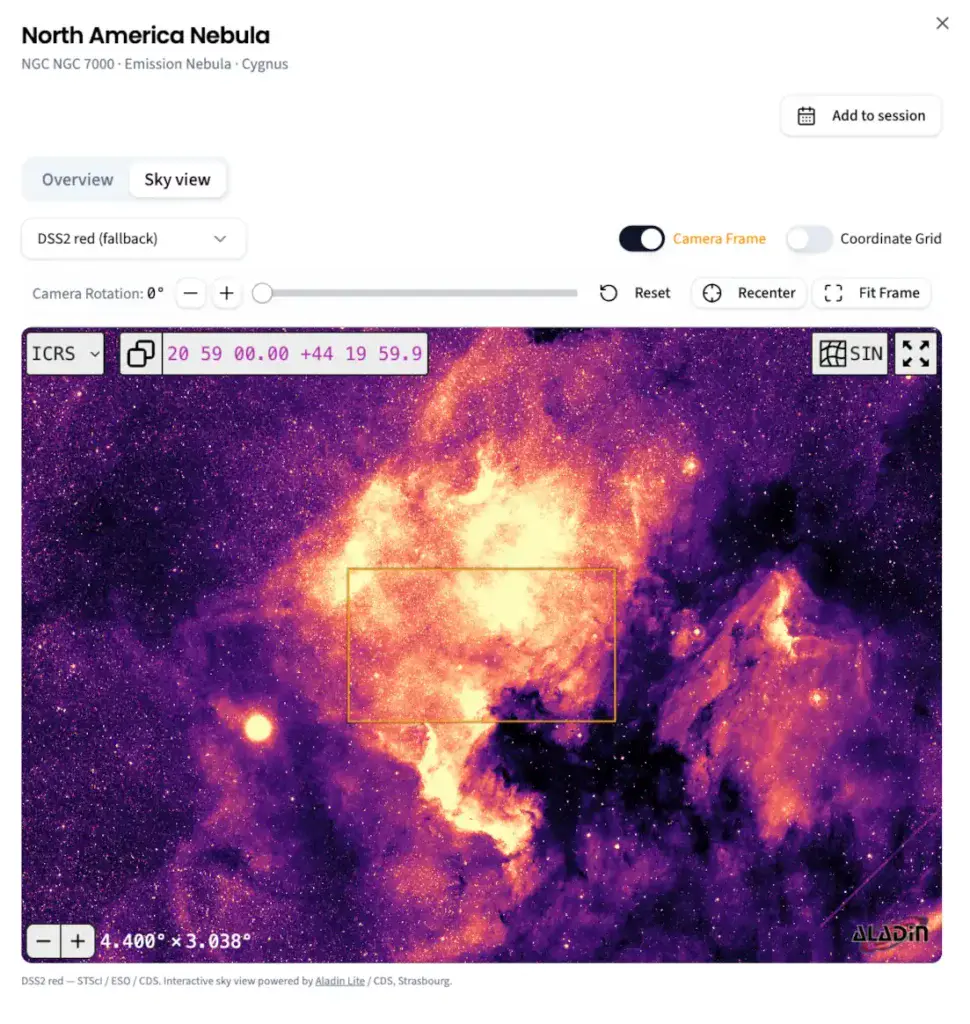
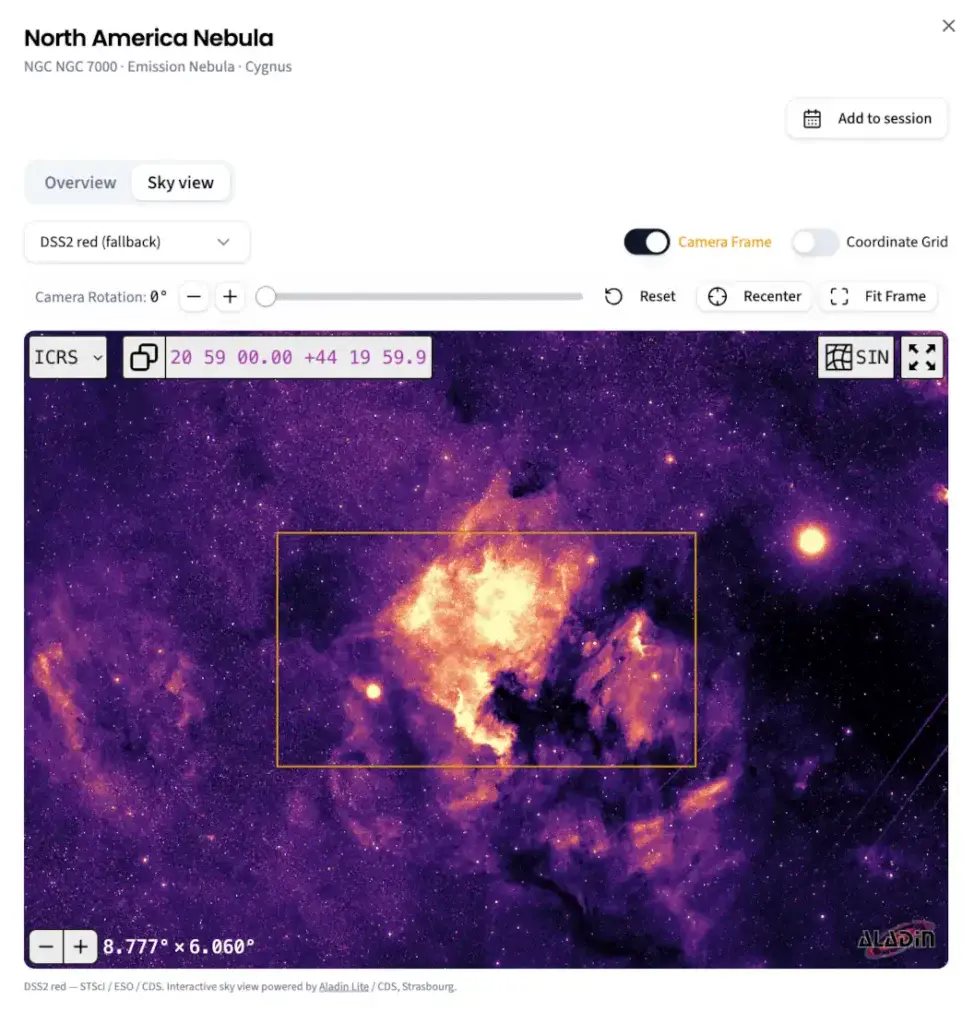
Both links open the Imaging Planner with the telescope and target already selected so you can examine the calculated framing yourself.
What About the Andromeda Galaxy?
The Andromeda Galaxy (M31) is another excellent example because it is much larger in the sky than many beginners expect. Its bright center is obvious, but the galaxy’s extended disk spans roughly three degrees. If you want to include the broader galaxy and its surroundings, field of view becomes important very quickly. The S30 Pro’s approximate 4.0° × 2.24° native field gives it considerably more room for a large target such as M31.
The DWARF 3’s approximately 2.93° × 1.65° field is tighter but still relatively wide. The DWARF Mini narrows things further. The S50’s approximately 1.28° × 0.72° native field is much smaller than M31’s full apparent extent, making mosaicking particularly valuable for a broad composition. That doesn’t make the S50 a poor choice for Andromeda. It means its native field is optimized differently.
Compare M31 Yourself
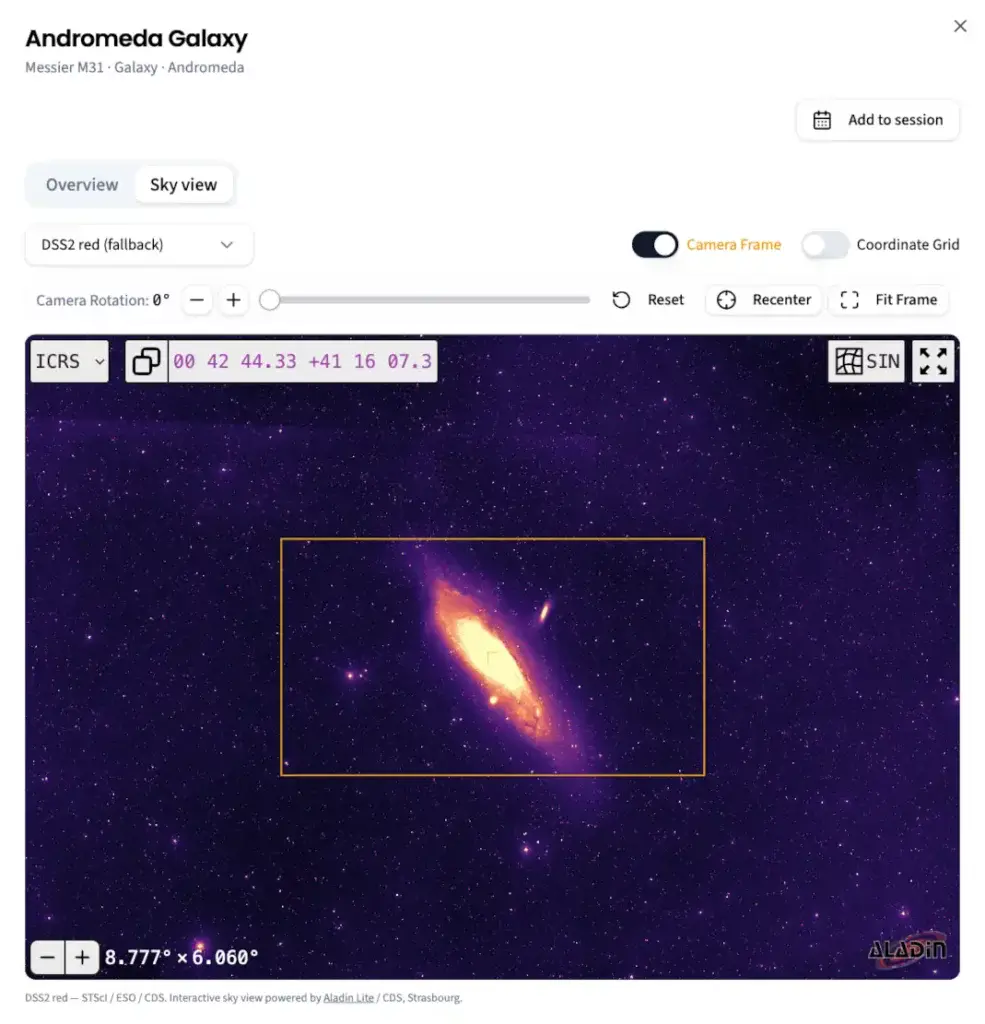
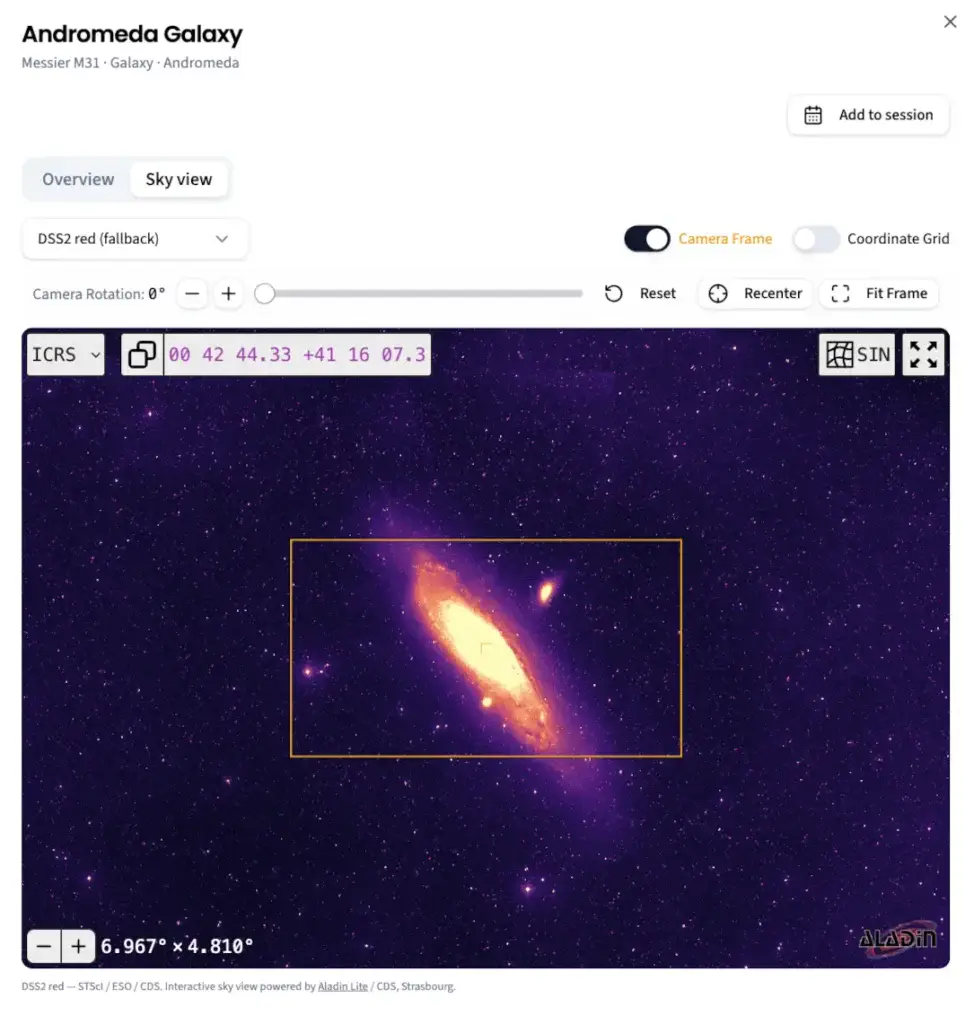
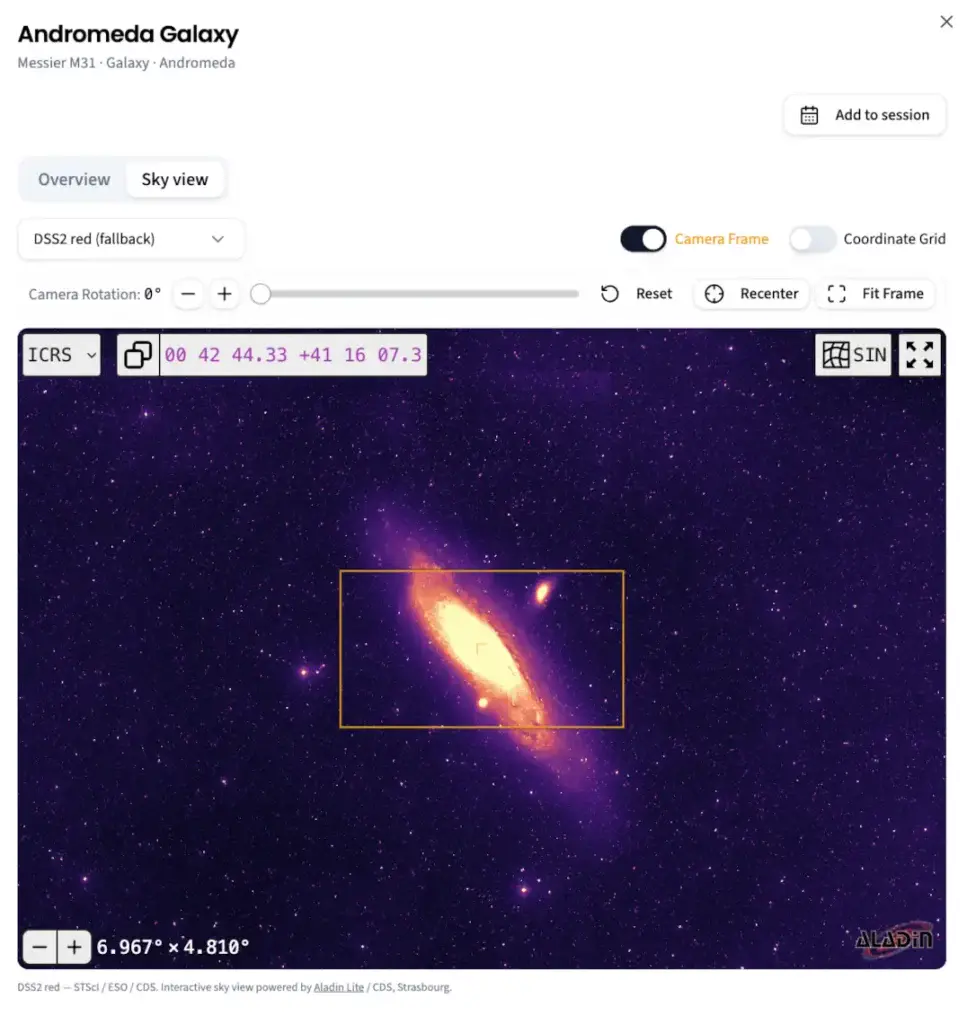
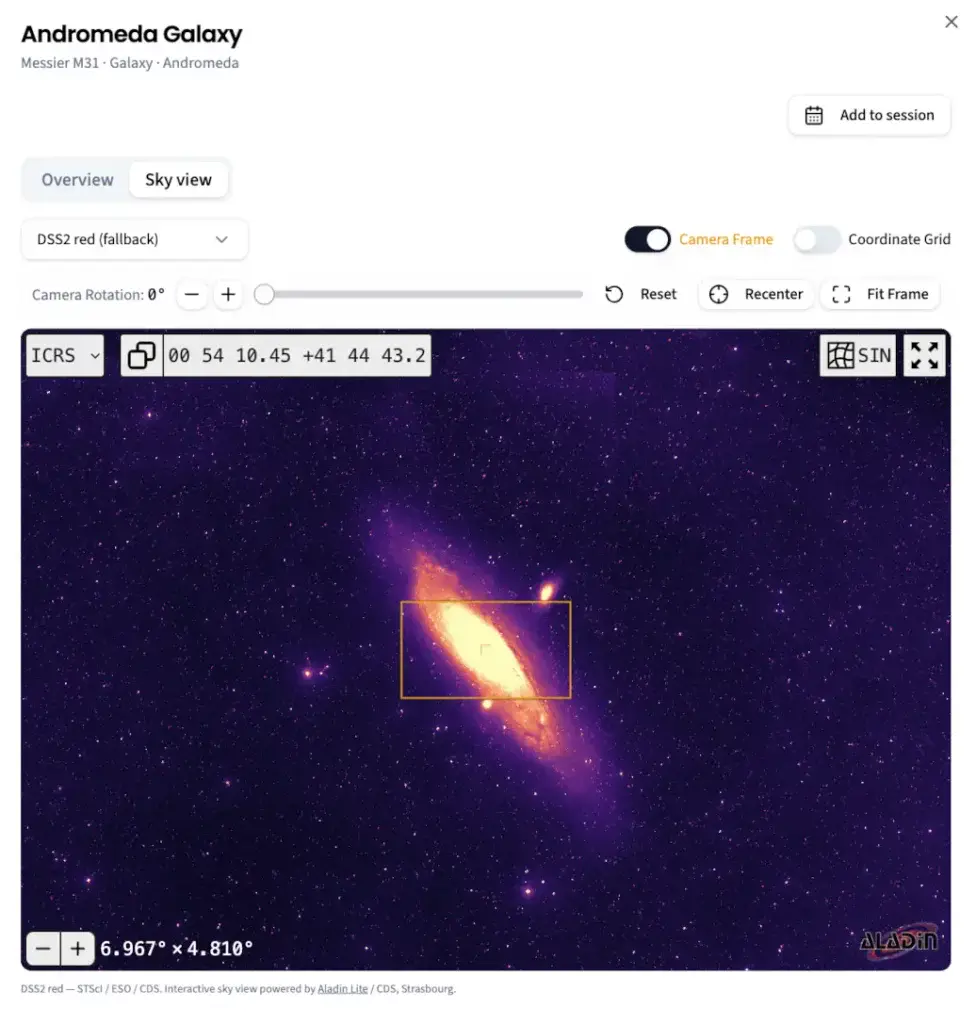
This is a particularly useful comparison because you can see the progression in framing across all four telescopes rather than simply relying on the specifications.
Smaller Galaxies Change the Equation
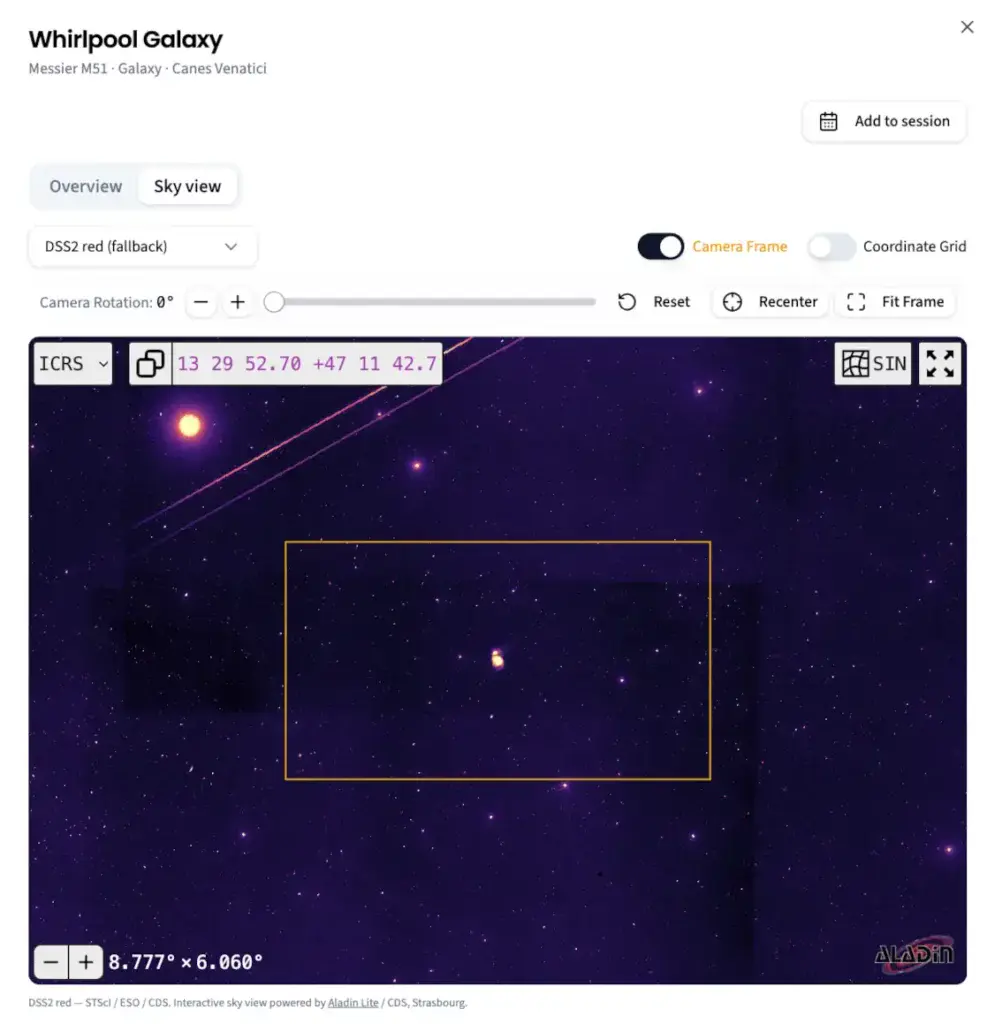
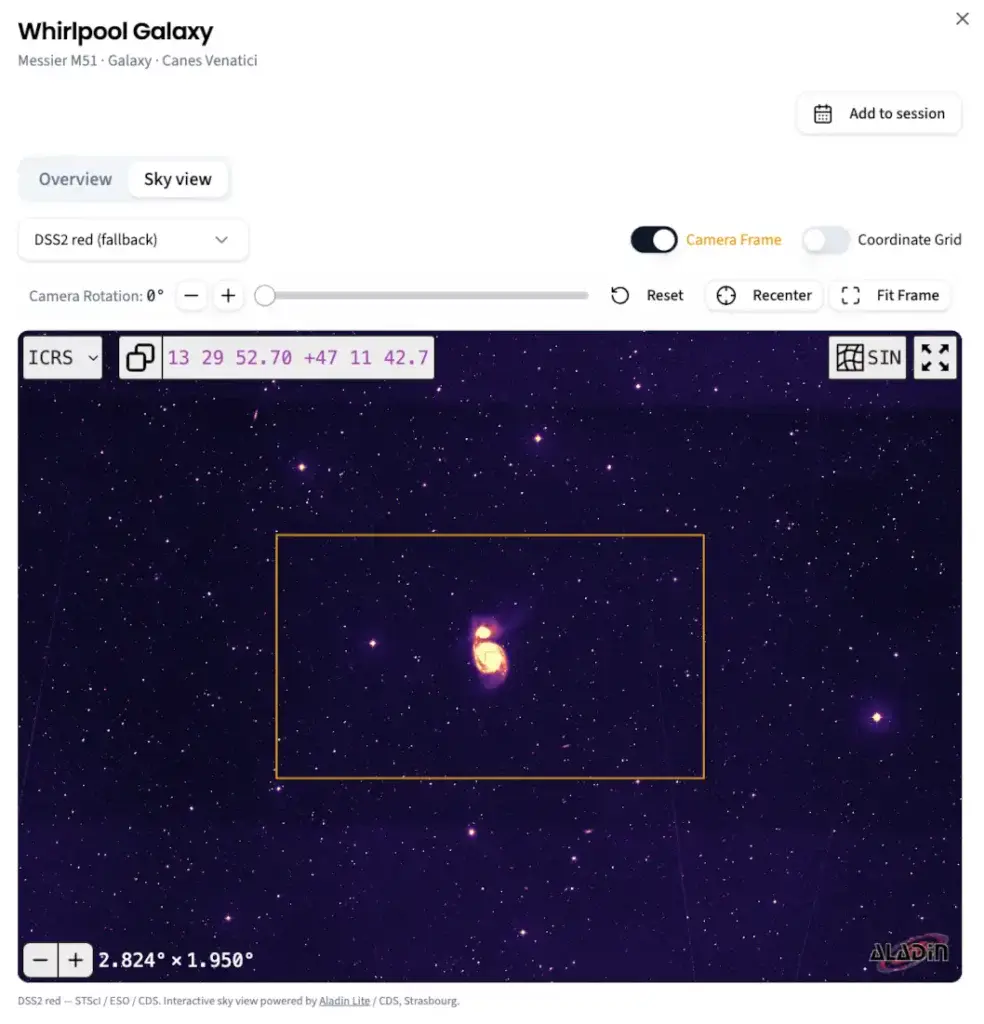
If we stopped with NGC 7000 and M31, it would be tempting to conclude that the widest field is always preferable. It isn’t. The Whirlpool Galaxy (M51) demonstrates the other side of the tradeoff. M51 occupies a tiny area of sky compared with the North America Nebula or Andromeda. Put a small galaxy into an extremely wide field and much of the image consists of surrounding sky. Now the S50’s 250 mm focal length becomes useful. The relationship between focal length and pixel size can be expressed as image scale—the amount of sky represented by each pixel. For these four telescopes, the approximate values are:
- Seestar S50: 2.39 arcseconds/pixel
- DWARF 3: 2.75 arcseconds/pixel
- Seestar S30 Pro: 3.74 arcseconds/pixel
- DWARF Mini: 3.99 arcseconds/pixel
At the same 2.9 µm pixel size, moving from the S30 Pro’s 160 mm focal length to the S50’s 250 mm focal length gives the smaller target more scale on the sensor. The S30 Pro can still image M51, of course. But the galaxy occupies a smaller portion of its much wider field. You can crop the image afterward, but cropping does not create additional captured detail. The DWARF 3 Is an Interesting Exception. The DWARF 3 has an even shorter 150 mm focal length, but its IMX678 sensor uses much smaller 2.0 µm pixels. That gives it an approximate image scale of 2.75 arcseconds per pixel—considerably finer sampling than you might expect if you looked only at focal length. This illustrates why focal length, pixel size and sensor dimensions need to be considered together. However, a smaller arcseconds-per-pixel number does not automatically mean a sharper astrophotograph. Aperture, atmospheric seeing, optical quality, tracking, focus, signal-to-noise ratio and processing all affect the amount of actual detail recorded. Image scale describes sampling; it doesn’t independently determine resolution.
See What Happens With M51
Sensor Size and Resolution Aren’t the Same Thing
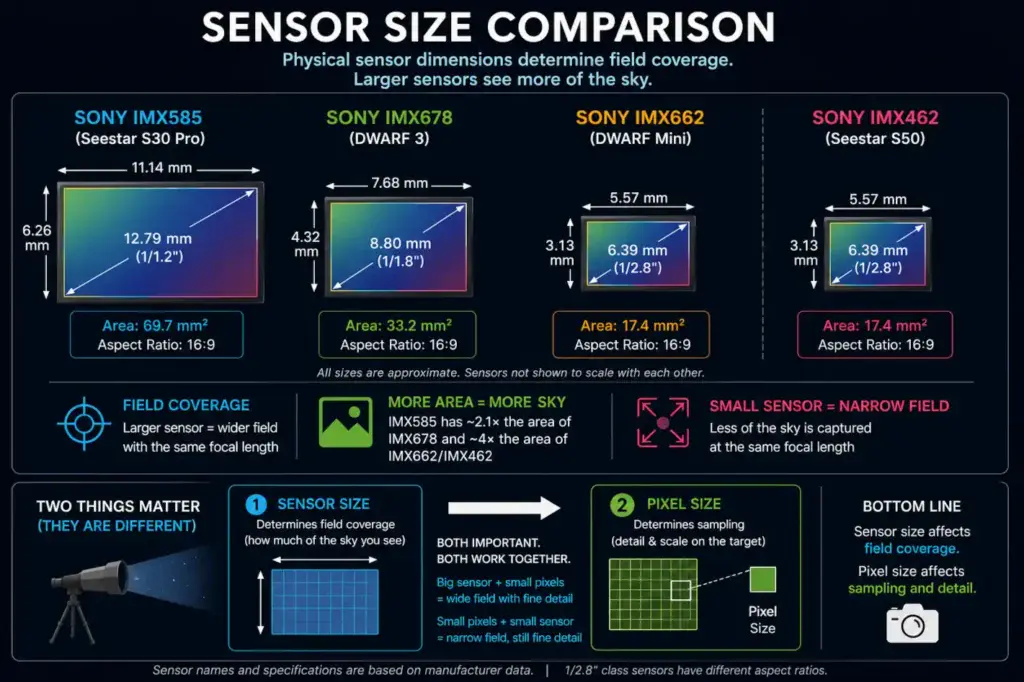
One of the easiest mistakes to make when comparing smart telescopes is treating output resolution as though it tells you the whole story about the camera. It doesn’t. The Seestar S30 Pro and DWARF 3 both produce 3840 × 2160 images, but they use different sensors and pixel sizes. The S30 Pro combines the larger IMX585 sensor with 2.9 µm pixels and a 160 mm focal length. The result is the widest native field in this comparison. The DWARF 3 uses the IMX678 with smaller 2.0 µm pixels. Its sensor covers less sky than the S30 Pro, but its smaller pixels provide finer angular sampling. Similarly, the S50 and DWARF Mini both produce 1920 × 1080 images and use 2.9 µm pixels, yet their 250 mm and 150 mm focal lengths give them dramatically different fields of view.
So I wouldn’t choose among these telescopes based on “1080p” versus “4K.” For astrophotography, it is much more informative to consider: sensor dimensions + pixel size + focal length together.
Equatorial Mode and Mosaics
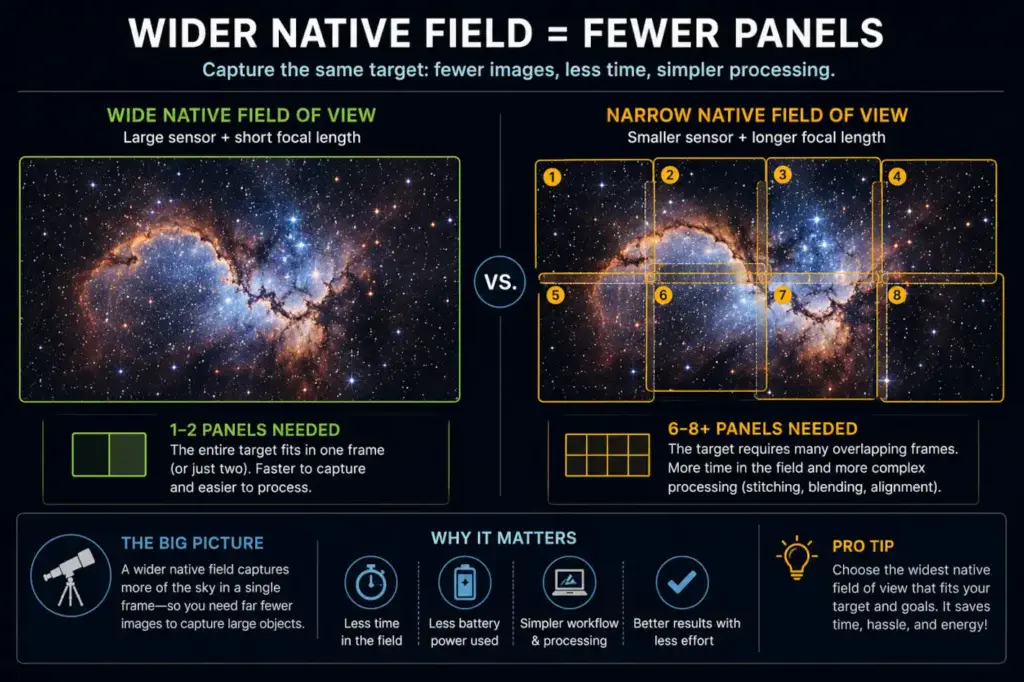
All four models in this comparison support an equatorial imaging mode according to their manufacturers. That’s an increasingly important feature in this class of telescope because an alt-azimuth tracking system introduces field rotation during long imaging sequences. Equatorial operation can reduce that limitation, making longer integrations more practical. Mosaic capability is equally important because it allows a smart telescope to build an image larger than its native field. But mosaic capability shouldn’t make us ignore the native field of view.
A telescope that begins with a wider field generally needs fewer panels to cover the same extended target. That can reduce total acquisition requirements and simplify the resulting imaging project. This is why I consider the S30 Pro’s large sensor an important feature rather than simply another number on the specification sheet.
Filters and Deep-Sky Imaging
The four telescopes also take somewhat different approaches to filtering. Both DWARFLAB models list multiple built-in light-filter options, while the Seestar systems use their own integrated or external filtering arrangements. Rather than simply counting filters, the important question is what those filters are designed to accomplish. For emission nebulae, filtering can help isolate important emission wavelengths while suppressing some unwanted artificial light. For broadband targets such as galaxies, aggressive narrowband-style filtering may be less appropriate. This is an area where I would choose the imaging mode and filter according to the target rather than assume that having more filters automatically makes one telescope superior.
Smart Scope Filter Options
| Smart Telescope | Filter Options |
| Dwarf 3 | Built-in filters: VIS, Duo-Band, Astro (telephoto) Astro (wide-angle) |
| Dwarf Mini | Built-in filters: VIS/IR Pass (Telephoto) VIS (Wide Angle) |
| SeeStar S50 | Built-in dark field filter, -UV/IR Cut Filter, light pollution filter optimized for OIII and Hα |
| SeeStar S30 Pro | Built-in duo-band filter optimized for OIII and Hα |
Which Is Easiest to Travel With?
Here the differences are much easier to quantify.
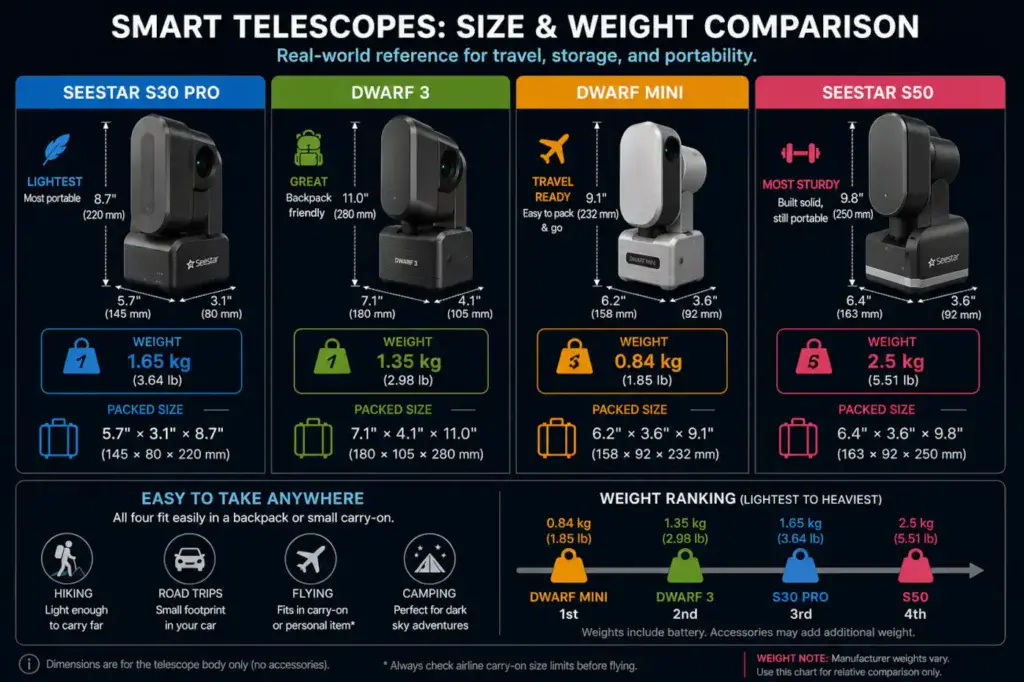
- DWARF Mini: 840 g / 1.85 lb
- DWARF 3: 1.35 kg / 2.98 lb
- Seestar S30 Pro: 1.65 kg / 3.64 lb
- Seestar S50: 2.5 kg / 5.51 lb
The DWARF Mini is by far the lightest of the four, weighing roughly one-third as much as the Seestar S50. That can matter for airline travel, camping, hiking, or simply carrying a telescope somewhere away from home. The S50 remains compact compared with a conventional telescope, mount and imaging system, but within the smart-telescope category it is clearly the heaviest of these four. So if minimum size and weight are major priorities, the DWARF Mini deserves particular attention.
Battery, Storage and Connectivity
The DWARF 3 has the largest listed battery capacity at 10,000 mAh, followed by the DWARF Mini at 7,000 mAh and the two Seestars at 6,000 mAh.Battery capacity alone shouldn’t be converted directly into observing hours because power consumption differs among the systems. Manufacturer runtime ratings are more useful when available under comparable conditions.
Storage is straightforward:
- 128 GB: DWARF 3 and Seestar S30 Pro
- 64 GB: DWARF Mini and Seestar S50
All four support wireless operation, and all four can be charged by USB according to the manufacturer specifications collected for this comparison. The DWARF models also list NFC-assisted connection in addition to Wi-Fi/Bluetooth. These are useful differences, but I wouldn’t make them the primary reason to choose one smart telescope over another unless a particular feature matters strongly to your intended use.
What About the Wide-Angle Cameras?
All four models include wide-angle capability in addition to their primary telephoto imaging systems. That makes target acquisition and broader views possible without relying solely on the narrow astronomical camera. The exact implementations differ, however, and I would evaluate the wide-angle system as a secondary feature rather than use it as a substitute for comparing the primary astronomical optics and sensors. For deep-sky imaging, the telephoto optical path remains the more important comparison.
Price and Value
At the time I collected the manufacturer pricing for this comparison:
- DWARF Mini: $419
- Seestar S50: $499
- DWARF 3: $549
- Seestar S30 Pro: $699
Prices change, so these should be treated as a snapshot rather than permanent pricing. More importantly, the least expensive telescope isn’t automatically the best value.
- The $419 DWARF Mini offers the lowest entry price and exceptional portability.
- For $80 more, however, the S50 provides a 50 mm aperture and 250 mm focal length that make it a substantially different imaging system.
- The DWARF 3 sits between the S50 and S30 Pro in price while offering 3840 × 2160 resolution, small 2.0 µm pixels, a relatively wide field, 128 GB of storage and the largest battery capacity in this comparison.
- The S30 Pro is the most expensive, but part of what you’re paying for is its particularly large native field coverage. For someone primarily interested in large nebulae and extended objects, that may be more valuable than aperture alone.
- Value therefore depends heavily on what you intend to image.
Which Smart Telescope Should You Buy?
Best for Wide-Field Deep-Sky Imaging: Seestar S30 Pro
For large nebulae, broad Milky Way regions and other extended targets, I give the Seestar S30 Pro the advantage. The reason isn’t its 30 mm aperture. It’s the combination of its 160 mm focal length and large IMX585 sensor. Its approximately 4.0° × 2.24° native field is substantially wider than the other telescopes in this comparison. That means more large targets fit naturally into the frame and fewer mosaic panels may be necessary when they don’t.
Best for Smaller Targets: Seestar S50
The Seestar S50 takes the opposite approach. Its 50 mm aperture is the largest in this group, and its 250 mm focal length gives it the narrowest native field and finest image scale of these four configurations. That makes it particularly interesting for smaller galaxies, globular clusters and other compact targets where filling more of the frame is desirable.
Best Balance of Wide Field and Fine Sampling: DWARF 3
The DWARF 3 occupies an interesting middle ground. Its 150 mm focal length provides a relatively broad field, while the IMX678’s 2.0 µm pixels produce finer sampling than either the S30 Pro or DWARF Mini. It doesn’t match the S30 Pro’s enormous field coverage or the S50’s longer focal length, but its combination of field width, sampling, 3840 × 2160 resolution, 128 GB storage and 10,000 mAh battery makes it a compelling alternative.
Best for Portability and Lowest Entry Price: DWARF Mini
At just 840 grams and $419 at the time of this comparison, the DWARF Mini has a very clear appeal. Its smaller sensor and 150 mm focal length don’t provide the field coverage of the S30 Pro, nor does it provide the image scale of the S50. But someone who prioritizes minimum weight, compact size, and cost may consider those worthwhile trade-offs.
My Bottom Line
The most important conclusion from comparing these four smart telescopes is that there isn’t a single specification that tells you which one is best.
- The Seestar S50 has the largest aperture.
- The Seestar S30 Pro has the widest native field.
- The DWARF 3 combines a fairly wide field with the smallest pixels.
- The DWARF Mini is the lightest and least expensive.
Which of those advantages matters most depends on what you want to photograph. That’s why I recommend looking beyond specification tables before choosing a smart telescope. Think about the targets that interest you most, then consider how the telescope’s focal length and sensor will actually frame them. And rather than trying to imagine the difference from the numbers, you can use the interactive examples throughout this article—or choose your own targets in the AstroPhotoGuru Imaging Planner—to see the framing yourself.
ANOTHER APPROACH — ADD SMART VIEWING TO A TELESCOPE YOU ALREADY OWN An all-in-one smart telescope is not the only route to automated live viewing. If you already own conventional telescopes and want the observing experience to change with the optical tube you choose, an electronic eyepiece/camera takes a different approach. Our Pegasus Astro SmartEye review explains how that EAA-style workflow differs from buying a fixed all-in-one smart telescope.
Ready to Choose?
If you’ve decided which smart telescope best fits your observing style, you can check current pricing and availability below:
- Dwarf 3➜ Check current pricing
- Dwarf Mini➜ Check current pricing
- Seestar S30 Pro➜ Check current pricing
- Seestar S50 Discontinued and likely only available on secondary market

