Pegasus Astro SmartEye Review: The Electronic Eyepiece That Bridges Visual Astronomy and Astrophotography
Walk outside with a telescope on any clear night and you’ll discover something that surprises almost every beginner. The Moon is breathtaking. Jupiter’s cloud bands are visible. Saturn’s rings are unmistakable. Then you point the telescope toward a famous galaxy or nebula…and suddenly the universe looks very different.
The Whirlpool Galaxy becomes a faint gray patch. The North America Nebula is difficult to see at all. Even the Orion Nebula, one of the brightest deep-sky objects, looks nothing like the colorful images you’ve seen online. This isn’t because your telescope is defective. It’s because your eyes simply aren’t very good at seeing faint color in extremely dim light.
For decades, astronomers accepted this limitation. If you wanted to see those spectacular colors and intricate structures, the answer was astrophotography—a rewarding but often complex hobby involving dedicated astronomy cameras, equatorial mounts, autoguiding, calibration frames, and image processing.
Today, however, a third option has emerged.
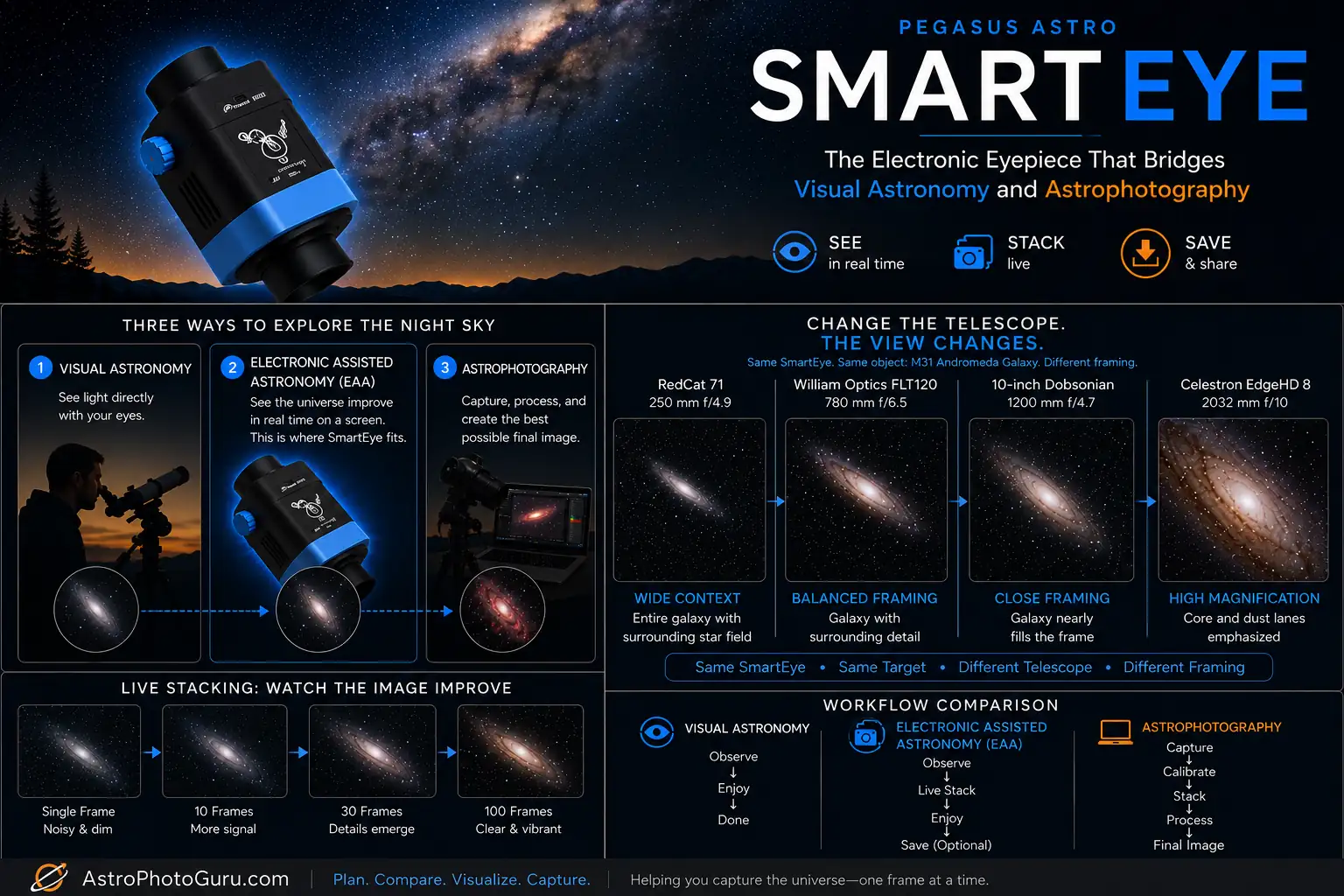
Electronic Assisted Astronomy (EAA) combines real-time electronic imaging with the simplicity of visual observing. Instead of waiting hours to process a photograph, you watch the image improve on a screen while you’re still observing. The Pegasus Astro SmartEye was designed to make that experience feel as natural as using a traditional eyepiece.
But calling it an “electronic eyepiece” doesn’t really tell the whole story. It isn’t simply an eyepiece. It isn’t just another astronomy camera. And it certainly isn’t a smart telescope. Instead, SmartEye creates an entirely new observing experience that sits somewhere between traditional visual astronomy and full astrophotography.
That’s exactly what makes it such an interesting product!
Three Ways to Explore the Night Sky
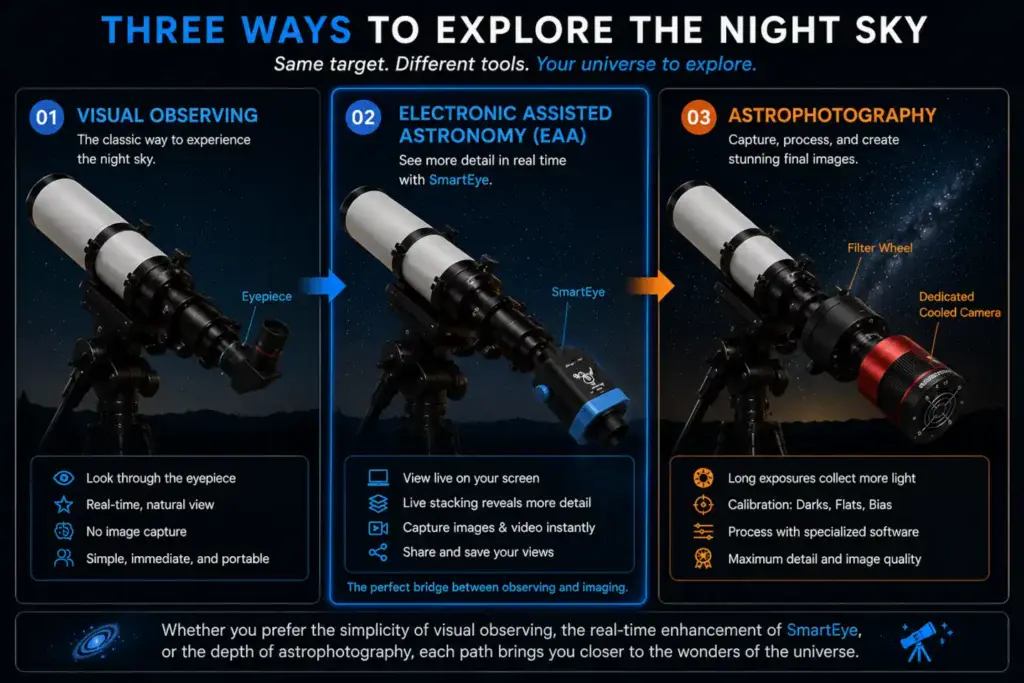
Understanding the SmartEye begins with understanding that modern amateur astronomy has evolved into three distinct observing experiences.
Traditional Visual Astronomy
This is the experience most astronomers know well. Light travels through your telescope and directly into your eye. There is something magical about seeing Saturn’s rings or resolving a globular cluster with your own eyes. The view is immediate, natural, and deeply personal.
The tradeoff is that the human eye simply cannot collect light the way a digital sensor can. Many galaxies appear as little more than faint gray smudges. Emission nebulae often show little or no color. Even very large telescopes remain limited by the capabilities of human vision.
Electronic Assisted Astronomy (EAA)
Electronic Assisted Astronomy changes only one part of the equation. Instead of your eye receiving the light, a highly sensitive electronic sensor does. The image appears on a display and continues improving as additional exposures are stacked together. Within seconds, faint structures begin to emerge.
Within minutes, spiral arms, emission regions, dust lanes, and color become increasingly apparent. Importantly, you are still observing in real time. You’re not collecting data for later processing. You’re watching the universe unfold while standing beside your telescope. This is where the Pegasus Astro SmartEye fits. Although the SmartEye can also save images for later use, its primary purpose is enhancing the live observing experience rather than replacing a traditional astrophotography workflow
Traditional Astrophotography
Astrophotography pursues a different goal. Rather than maximizing the live observing experience, it aims to produce the highest possible final image. That usually involves longer exposures, calibration frames, guiding, sophisticated processing software, and significant post-processing time.
The results can be spectacular—but they also require considerably more equipment, experience, and patience. The SmartEye doesn’t attempt to replace astrophotography. Nor does it replace traditional visual observing. Instead, it fills the gap between them. For many amateur astronomers, that gap has existed for years.
Interested in the Pegasus Astro SmartEye?
Check the latest availability and current pricing from our recommended astronomy retailer.
Why SmartEye Is Different
One of the biggest misconceptions about the SmartEye is that it’s simply another astronomy camera. Technically, it does contain an astronomical imaging sensor (in this case the SONY IMX 533). Practically, however, that’s missing the point. Most astronomy cameras are designed to become part of an imaging system. They expect a laptop, smart device, or mini-computer, capture software, guiding, calibration frames, and image processing.
SmartEye takes a very different approach. It was designed to become part of the observing experience itself. Rather than replacing your telescope, it replaces the eyepiece. Rather than sitting inside an imaging workflow, it allows you to remain engaged with the telescope while electronic imaging quietly enhances what you see. That distinction may sound subtle, but it’s the reason SmartEye appeals to an entirely different audience than someone shopping for a cooled deep-sky astronomy camera. The SmartEye isn’t designed to replace the telescope you own. It’s designed to help you see more through it.
Specifications at a Glance
Before diving into the SmartEye’s capabilities, here are the most important specifications.
| Camera sensor | Sony IMX533 cooled CMOS |
| Sensor size | 11.31 x 11.31 mm (16mm diagonal) |
| Resolution | 3008 x 3008 pixels |
| Pixel size | 3.76 microns |
| Display specifications | 2560 x 2560 UHD OLED |
| Internal storage | SD Card Reader |
| Cooling | -30C below ambient |
| Connectivity | WiFi, Bluetooth |
| Weight | 795g |
| Supported telescope compatibility | Standard 2" (1.25" requires adapter) |
| Software Compability | iOS/Android app, ASCOM via USB to PC |
Rather than simply listing specifications, it’s worth understanding what they actually mean for observers.
Features That Matter in the Real World
Many astronomy products impress with long specification sheets, but only a handful of features significantly affect the observing experience.
It’s Built Around the Sony IMX533 Sensor
One of the SmartEye’s biggest strengths is its use of the Sony IMX533 sensor.
The IMX533 has become one of the most respected sensors in amateur astrophotography because it offers an excellent balance of sensitivity, low noise, and image quality. While SmartEye uses that sensor for a different purpose than a dedicated cooled astronomy camera, it still benefits from the sensor’s excellent performance. For observers, that means cleaner live images, better low-light performance, and the ability to reveal details that simply aren’t visible through a traditional eyepiece. And its square format provides a balanced field of view that works well across a wide variety of astronomical targets.
Live Stacking Makes the Difference
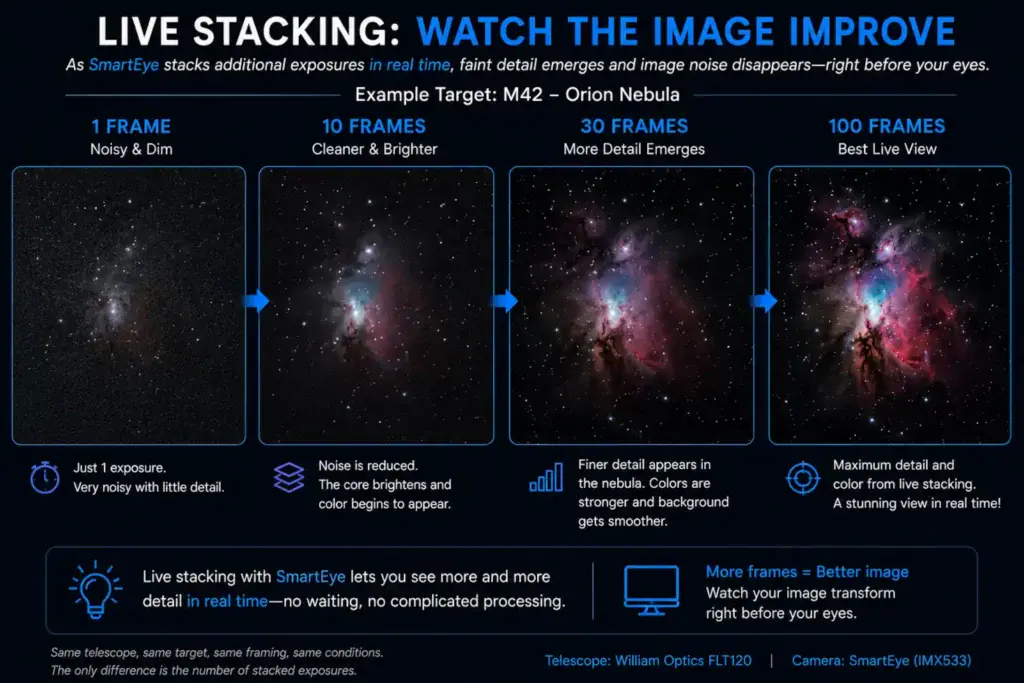
Perhaps the SmartEye’s most important feature isn’t the sensor at all. It’s live stacking. Rather than showing a single exposure, SmartEye continuously combines multiple exposures in real time. Each new frame improves the image. Noise decreases. Faint structures become easier to see. Colors gradually appear. Instead of waiting until the next day to process images, you’re watching the improvement happen while standing beside the telescope. This is one of the defining characteristics of Electronic Assisted Astronomy.
Live stacking also changes the observing experience psychologically. Instead of taking a single glance through an eyepiece and moving on, you’re encouraged to watch the object gradually reveal itself. Each new exposure contributes a little more detail, turning observing into an interactive process rather than a static one.
Capture and Share the Experience
One of the advantages of the SmartEye is that your observing session doesn’t have to end at the eyepiece. While its primary purpose is enhancing live views through Electronic Assisted Astronomy (EAA), the SmartEye can also save still images and video clips for later viewing or sharing.
That makes it easy to preserve memorable observing sessions, share your discoveries with friends and family, or post your results online without committing to a traditional astrophotography workflow. The saved images won’t replace hours of carefully processed long-exposure imaging, but they provide an excellent record of what you observed and can be surprisingly impressive given how quickly they are captured.
For many observers, that balance is one of the SmartEye’s greatest strengths—it lets you enjoy the night sky in real time while still bringing home something to remember the experience.
- 👁️ Observe
- ✨ Live Stack
- 💾 Save – Internal storage or SD card
- 📱 Share
Why Not Just Buy an Astronomy Camera?
At first glance, the SmartEye might seem similar to a traditional astronomy camera. After all, both use highly sensitive imaging sensors capable of revealing faint deep-sky objects. The difference lies in how they’re intended to be used.
A conventional astronomy camera is designed as one component of a larger imaging system. It typically requires a computer or smart controller, capture software, external power, image calibration, and post-processing to produce its best results. The SmartEye follows a different philosophy. Rather than building an imaging workflow around the telescope, it brings electronic imaging directly into the observing experience. The emphasis is on simplicity, immediacy, and enjoying the night sky as it unfolds.
For many observers, that distinction is more important than raw imaging performance. The goal isn’t replacing astrophotography. It’s making every observing session more rewarding.
It Uses the Telescope You Already Own
One of the SmartEye’s greatest advantages is that it doesn’t lock you into a single optical system. Unlike a smart telescope, the SmartEye works with the telescope you already own. Whether that’s:
- an 80 mm refractor,
- a 120 mm triplet,
- an 8-inch Schmidt-Cassegrain,
- or a Dobsonian,
the SmartEye adapts to the optical system. That flexibility is both its greatest strength and something prospective buyers should understand before purchasing.
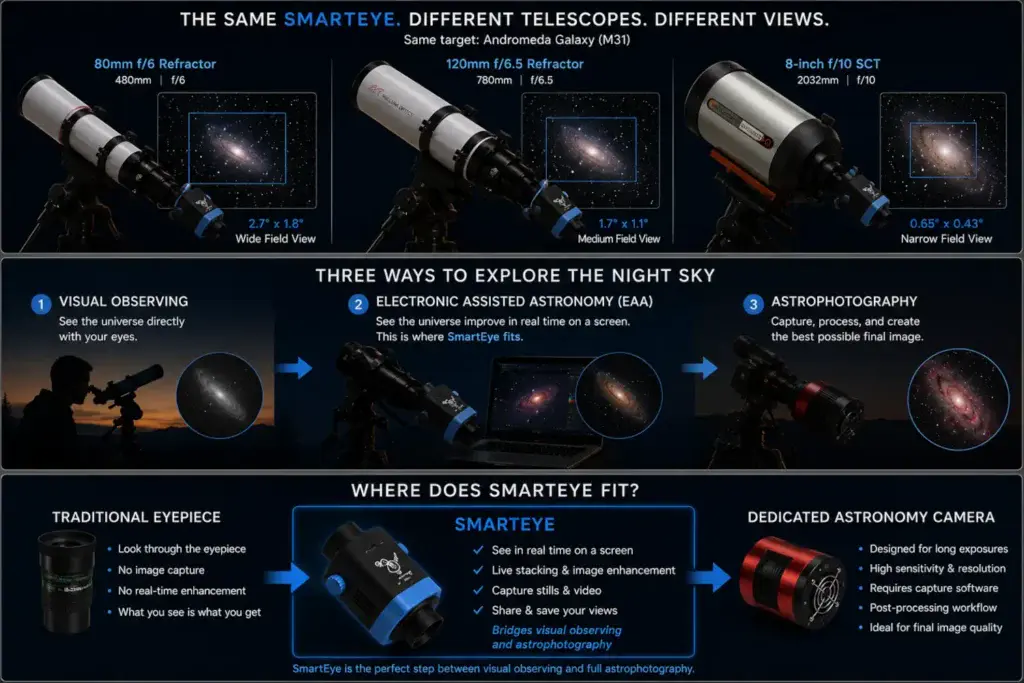
ASTROPHOTOGURU TIP — THE SAME CAMERA CAN SHOW A COMPLETELY DIFFERENT SKY Changing telescopes while keeping the same camera changes field of view and image scale because focal length is part of both calculations. An 80 mm refractor can provide a broad nebula-friendly view, while a long-focal-length SCT may place a small galaxy or planetary nebula much larger in the frame. Our image-framing guide explains the relationship between sensor size, focal length and composition.
The Same SmartEye Can Produce Completely Different Results
This is one of the concepts that surprises many first-time buyers. Changing the telescope changes everything. The camera remains identical. The telescope changes. Yet the field of view can be dramatically different.
A short focal length refractor can frame enormous nebulae. A long focal length Schmidt-Cassegrain can fill the frame with galaxies and planetary nebulae.
Neither is “better.” They’re simply optimized for different targets. The telescope you pair with SmartEye also plays a significant role. Aperture, focal length, focal ratio, sky conditions, and the target itself all influence the final observing experience. A fast, short focal-length refractor can capture the faint details of a large object, like the North America Nebula, very quickly. A long focal-length Schmidt-Cassegrain delivers a different experience. It is better suited for a smaller object, like the Whirlpool Galaxy.
Try These SmartEye Configurations Yourself
This is also where the AstroPhotoGuru Imaging Planner becomes especially valuable. The SmartEye itself never changes, but the telescope you attach it to changes everything—from image scale to field of view. Instead of imagining those differences, you can explore them interactively. Look how different telescopes attached to the SmartEye are suited for different objects:
Wide-Field Deep Sky
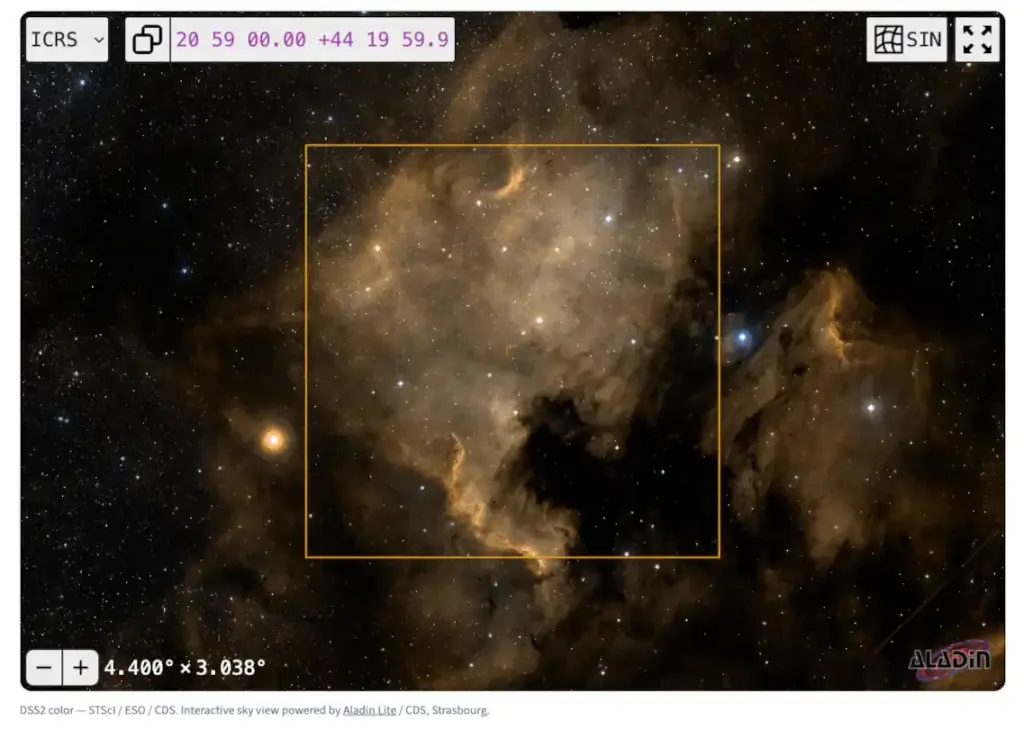
SmartEye + William Optics RedCat 71 + NGC 7000 (North America Nebula)
Large Emission Nebulae
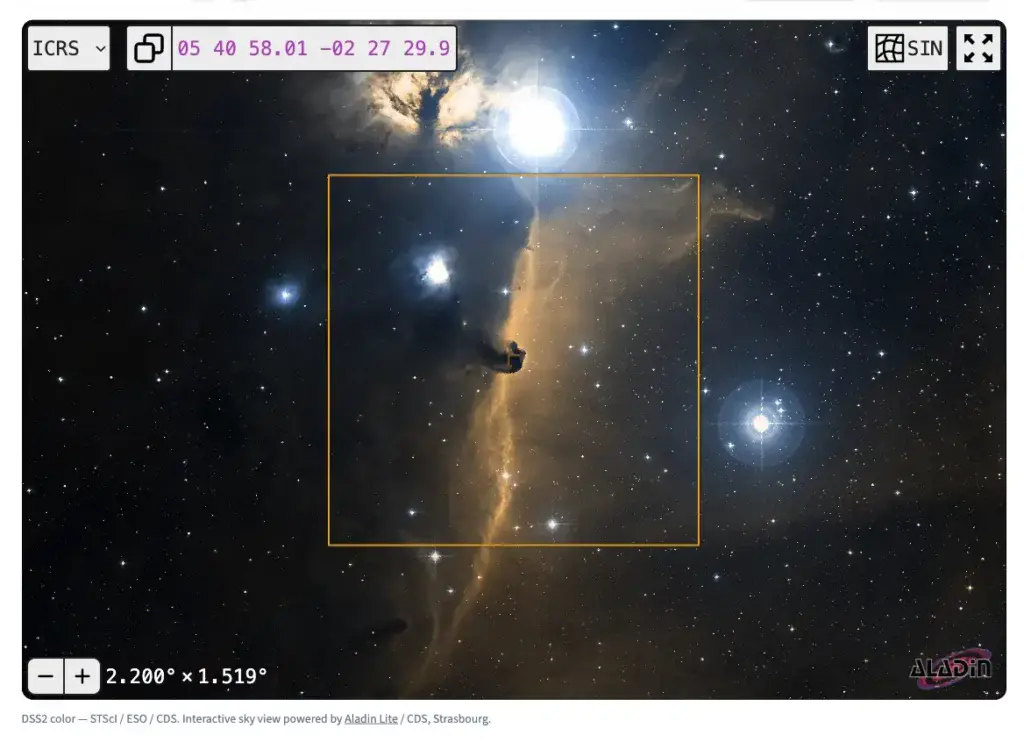
SmartEye + William Optics FLT 120 + IC 434 (Horsehead Nebula)
Galaxies
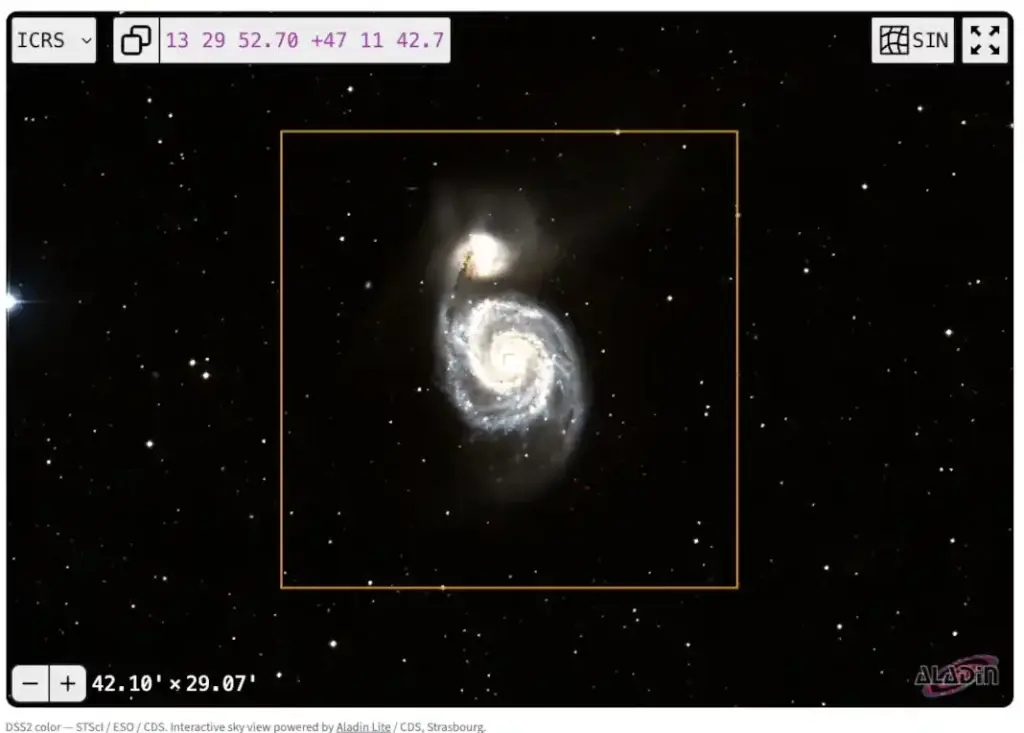
SmartEye + Celestron EdgeHD 800 + M51 (Whirlpool Galaxy)
Globular Clusters
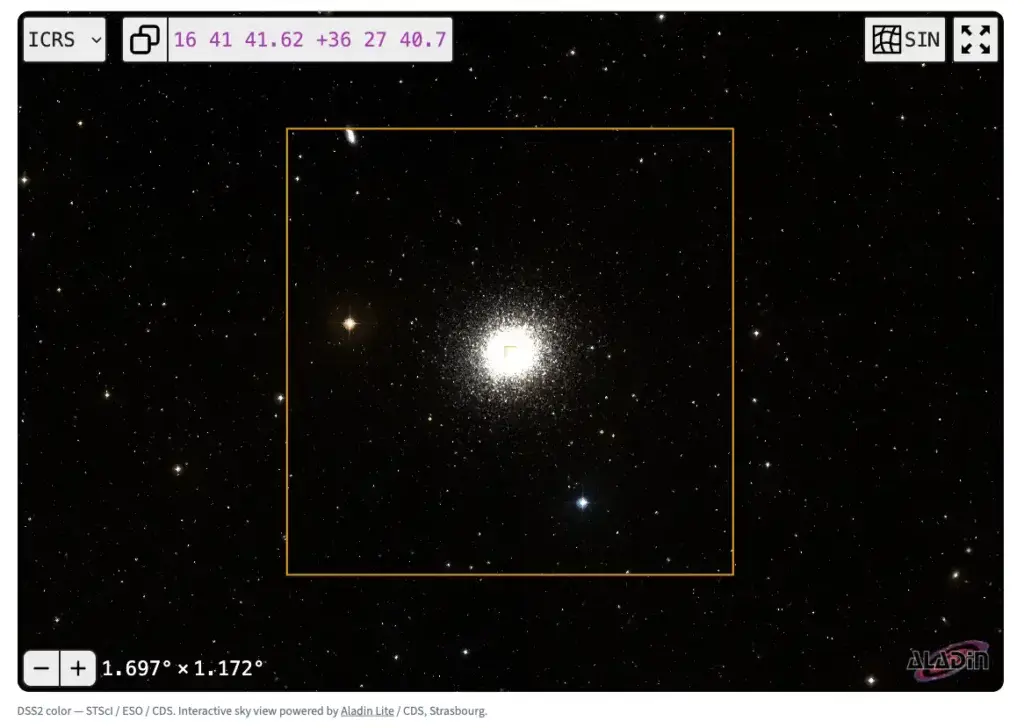
SmartEye + Sky-Watcher Esprit 120 + M13 (Great Hercules Cluster)
Each link opens the Planner with the equipment already selected, allowing you to compare targets, change telescopes, and explore different framing options interactively.
What kind of Images Should You Expect?
One of the easiest mistakes to make when evaluating the SmartEye is comparing it directly to long-exposure astrophotography. That isn’t what it was designed to do. Traditional astrophotography often combines hours of exposure time, calibration frames, careful image processing, and advanced editing techniques to produce stunning final photographs.
The SmartEye pursues a different goal. Its objective is to improve the observing experience while you’re still standing beside the telescope. As live stacking continues, the view gradually becomes cleaner and more detailed. Faint galaxies become easier to detect. Nebulae begin revealing structure and color that simply aren’t visible through a conventional eyepiece.
That doesn’t mean every live image will resemble an award-winning astrophotograph. Instead, think of SmartEye as revealing what your telescope is capable of showing in real time. For many observers, that’s exactly the experience they’ve been looking for—a deeper view of the night sky without turning every observing session into a full imaging project.
SmartEye vs. Smart Telescopes
At first glance, products like the ZWO Seestar series or DWARFLAB smart telescopes might appear to compete directly with the SmartEye. In reality, they solve very different problems. A smart telescope is a complete observing system. It includes the telescope, mount, camera, software, and automation in one integrated package. Everything is optimized to work together.
WHY THIS MATTERS — FIXED SYSTEM VS. FLEXIBLE OPTICAL TRAIN A smart telescope fixes the telescope, camera and mount into one optimized system. SmartEye does the opposite: the camera/eyepiece remains the same while the telescope determines the focal length, aperture and resulting field of view. If simplicity is the priority, our smart-telescope buying guide explains the all-in-one route. If you want to see how dramatically different optical systems change the composition, use the Imaging Planner to compare the same target at different focal lengths.
The SmartEye takes the opposite approach. Instead of replacing your telescope, it enhances the telescope you already own. That means the experience changes dramatically depending on which telescope you use. An 80 mm apochromatic refractor produces a very different field of view than an 8-inch Schmidt-Cassegrain. A fast Newtonian offers another completely different experience.
One of the biggest advantages of the SmartEye is that it grows with your telescope collection instead of limiting you to a single optical system.
Who Should Consider the SmartEye?
The answer depends much more on how you enjoy astronomy than on which telescope you own.
The Pegasus Astro SmartEye may be an excellent choice if you:
- Already own a telescope and want to reveal more detail without learning a complete astrophotography workflow.
- Enjoy sharing the night sky with family, friends, or astronomy club members.
- Participate in public outreach events where several people can enjoy the same live view.
- Want to explore faint nebulae and galaxies that are difficult to appreciate visually.
- Like the idea of observing first and photographing second.
On the other hand, SmartEye may not be the ideal solution if your primary goal is producing publication-quality astrophotographs through hours of data collection and extensive post-processing. Likewise, observers interested primarily in high-speed planetary imaging may find a dedicated planetary camera better suited to that specific task. That doesn’t make SmartEye better or worse than those alternatives.
It simply means it’s solving a different problem.
Ready to Learn More?
If the Pegasus Astro SmartEye seems like the right fit for your observing style, you can check current pricing, availability, and specifications from our recommended retailer.
➡ View the Pegasus Astro SmartEye
(Affiliate link — if you purchase through this link, AstroPhotoGuru may earn a small commission at no additional cost to you. Thank you for supporting our work.)
See What SmartEye Looks Like Through Different Telescopes
One of the biggest questions prospective buyers ask is:
“What will I actually see through my telescope?”
That’s where the AstroPhotoGuru Imaging Planner becomes especially useful. Instead of guessing how the SmartEye will perform, you can view the calculated field of view using your telescope—or compare multiple telescopes side by side.
Examples:
Small Object: Ring Nebula (M57) as viewed with the SmartEye and Celestron 8″ SCT and a 2.5X Barlow Lens
Large Object: Veil Nebula (NGC 6960) as viewed with the SmartEye and Short Focal Length RedCat51 WIFD
These interactive examples let you explore framing before making a purchasing decision.
Strengths
- Extremely easy to integrate into an existing telescope.
- Excellent Sony IMX533 sensor.
- Real-time live stacking dramatically improves faint-object visibility.
- No need for a complicated astrophotography workflow.
- Ideal for outreach and shared observing sessions.
- Works with many different telescope designs.
Limitations
No product is perfect, and understanding the SmartEye’s limitations helps determine whether it’s the right tool for your style of observing.
- Premium price compared with conventional eyepieces.
- Final image quality won’t replace long-exposure astrophotography.
- Performance depends heavily on the telescope it’s paired with.
- Existing telescope owners benefit the most.
Final Verdict
The Pegasus Astro SmartEye isn’t trying to replace your favorite eyepiece. It isn’t trying to replace a dedicated astronomy camera. And it isn’t trying to compete directly with today’s smart telescopes. Instead, it creates a new way to experience the night sky.
For visual observers, it reveals details that were previously hidden. For Electronic Assisted Astronomy enthusiasts, it simplifies live observing. For experienced astrophotographers, it offers an entirely different way to enjoy a telescope without committing every clear night to a lengthy imaging session. Perhaps the most impressive thing about the SmartEye isn’t the sensor or the display. It’s that it encourages you to spend more time observing.
If you’ve ever wished you could see more through the telescope you already own—without building a traditional astrophotography workflow—the Pegasus Astro SmartEye may be one of the most compelling astronomy products available today.
And because every telescope produces a different field of view, one of the best ways to understand what SmartEye can do is to see it on your own equipment. Explore the example configurations in the AstroPhotoGuru Imaging Planner, compare different telescopes, and discover which combination best matches the way you enjoy the night sky.
Where to Buy the Pegasus Astro SmartEye
We recommend purchasing from established astronomy dealers that provide manufacturer support and warranty service.

