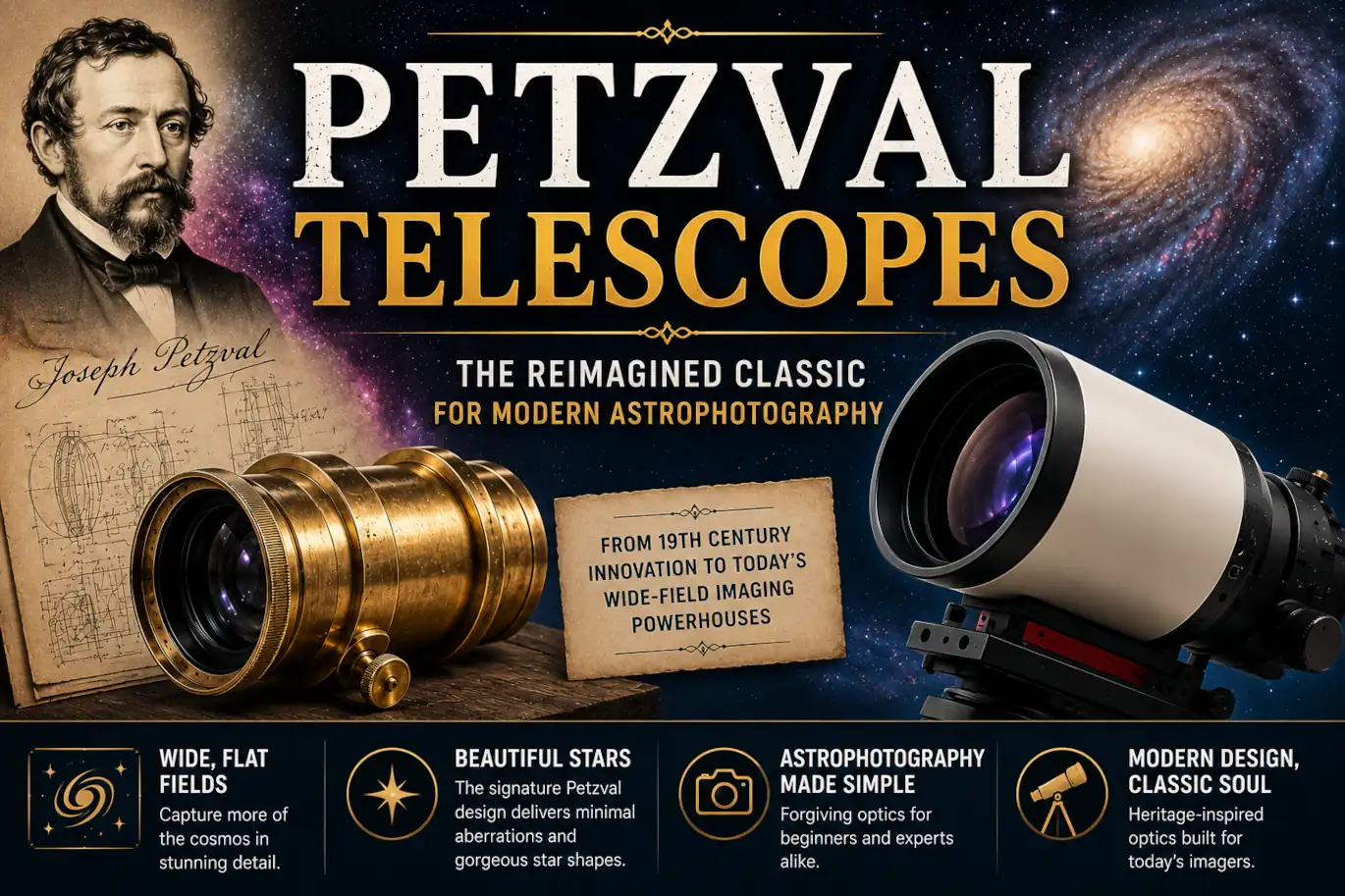
If you’re aiming for detailed, crisp, and edge-to-edge sharp images of the night sky, you’ve probably wondered what the best telescope design is for astrophotography. In practical tests and head-to-head comparisons, the Petzval design refractor stands out for its user-friendly performance and high image quality.
This style of telescope brings distinct operational advantages to the table, and it is steadily gaining popularity among amateur and advanced astro-imagers alike.
This overview breaks down why this optical design is worth a closer look, covers the optical science behind it, highlights popular models, and details the specific features that make a Petzval practical when capturing deep sky or widefield images.
As someone who knows a little bit about telescopes, I highly recommend spending a few extra bucks to get a refractor with the Petzval design if you really want the best results without additional setup. You won’t regret it.
There are many high-quality refractors out there, but many suffer from the same issues, particularly with large sensors. For smaller sensors, you can probably get away with a non-Petzval refractor since the issues of vignetting and coma will fall outside the useful image circle.
What is a Petzval Telescope Design?
The Petzval telescope design is a type of refracting telescope that uses a combination of lenses to create a flat, well-focused image across a wide field of view. Unlike classic doublet or triplet refractors (which place two or three lens elements at the front of the optical tube), a typical Petzval adds an integrated internal group of lenses further down the optical path. This second group—frequently referred to as the correcting group, field flattener group, or Petzval element—fundamentally changes the optical behavior for astrophotography.
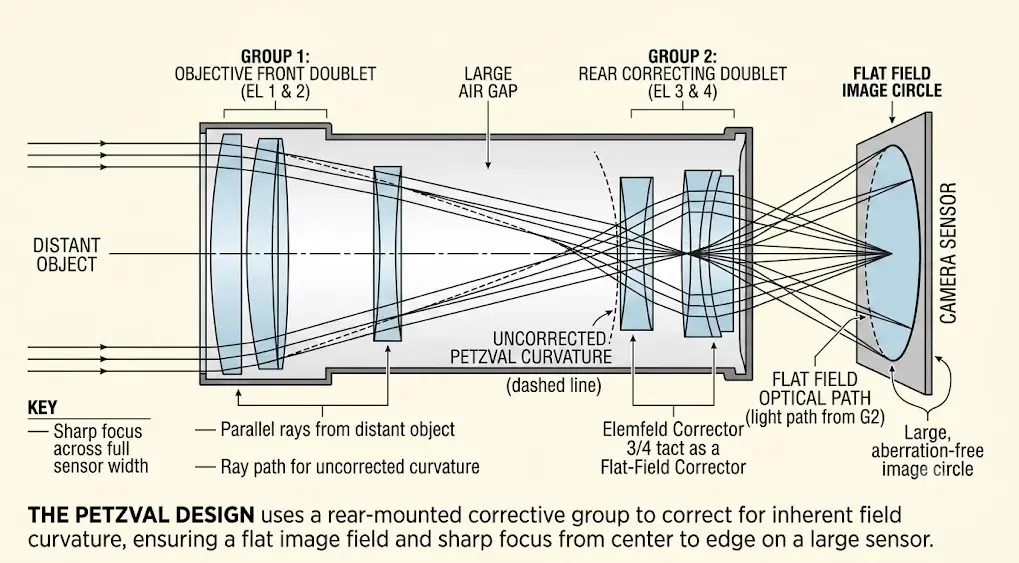
A standard Petzval refractor usually features four lenses arranged in two widely separated pairs. The front objective group gathers incoming light and establishes primary focus, much like a traditional refractor. However, the rear group corrects for inherent field curvature and projects a flat image directly onto the camera sensor. This produces sharp, round stars across the entire frame—including the corners—without requiring external corrective optics.
Why Petzval Optics Are Well-Suited for Astrophotography
Astrophotography highlights a telescope’s optical strengths and weaknesses, particularly when paired with large modern camera sensors. The primary advantage of a Petzval telescope design is that it delivers an intrinsically flat field without requiring the addition, adjustment, or purchase of a separate field flattener.
- Flat Image Across the Field:** Standard refractors suffer from natural field curvature, causing stars in the corners of the frame to stretch or blur. Petzval designs correct this optically within the tube, maintaining tight, round stars across the full frame.
- No Need for External Flatteners:** Astrophotographers can skip the complex trial-and-error process of sourcing, threading, and measuring exact mechanical spacing for an external flattener. Petzval optical systems are effectively ready for imaging out of the box.
- Wide and Fully Illuminated Image Circle:** High-quality Petzval astrographs provide full illumination across large image circles (supporting APS-C and full-frame sensors), preventing severe edge vignetting or optical drop-off.
- Simplified Setup:** Fewer external threaded components translate to fewer mechanical tilt points, less focusing troubleshooting, and more time dedicated to imaging.
- Consistent Performance:** Because the correcting optics are fixed inside the factory-aligned optical tube, swapping cameras, filter wheels, or visual accessories will not alter the internal optical correction.
How The Petzval Optical Path Works
The functional advantages of this optical layout become clear when comparing ray traces side-by-side. Traditional refractors focus light toward a curved focal plane. This means light rays from the edge of the field do not reach focus at the same physical plane as light rays from the center.
This results in out-of-focus corners, known as field curvature, which is especially noticeable on larger sensors.
The Petzval arrangement positions an internal field-correcting lens group behind the primary objective. This correcting group bends off-axis light rays so that light from both the perimeter and center of the field focus at the exact same flat plane. The result is sharp corners and uniform focus across the sensor area. Additionally, this layout aids in controlling off-axis astigmatism and optical aberrations, maximizing sensor resolution.
The Petzval arrangement positions an internal field-correcting lens group behind the primary objective. This correcting group bends off-axis light rays so that light from both the perimeter and center of the field focus at the exact same flat plane.
The Petzval design’s rear-mounted corrective element works specifically to eliminate native field curvature.
This yields visual and photographic sharpness across wide fields of view and larger camera sensors that challenge traditional refractor designs.
Comparing Petzval to Standard Refractors
Classic doublet and triplet refractors deliver excellent color correction and high central sharpness, but they inherently project a curved focal plane. Resolving this curvature on a standard refractor requires an external field flattener. While effective, external flatteners add cost, weight, and critical backfocus requirements (often requiring precise tolerance down to fractions of a millimeter between the corrector glass and camera sensor).
With a Petzval refractor, field flattening is integrated into the core optical design. Users achieve sharp edge-to-edge images straight out of the box without calculating backfocus distances from an external lens. Traditional refractors remain widely used and effective, but for a plug-and-play workflow on modern sensors, the Petzval design offers distinct convenience.
Furthermore, Petzval systems exhibit high optical stability during fast imaging sessions. Eliminating external corrective accessories reduces structural flexure in the imaging train and streamlines hardware management during multi-night shooting projects or complex mosaic captures.
For widefield nebula imaging, multi-panel mosaics, or high-resolution deep-sky targets, the Petzval layout reduces technical snags during setup.
Real-World Performance and Practical Advantages
Focusing is straightforward, and exposures maintain uniform star shapes.
Under real sky conditions, the practical differences between Petzval and standard refractors become immediately apparent.
When paired with full-frame or APS-C sensors, a Petzval refractor yields pinpoint stars across the entire field without requiring delicate spacing rings or adjustable backfocus adapters.
For widefield nebula imaging, multi-panel mosaics, or high-resolution deep-sky targets, the Petzval layout reduces technical snags during setup. Because the image field is flat at any native focus point, imagers spend less time troubleshooting star distortion or cropping outer frame boundaries during post-processing, significantly improving overall workflow efficiency.
Some Notable Petzval Refractors
- Askar 60F
- Radian Raptor 75
- Takahashi FSQ-85EDX
- Tele Vue NP101is and NP127is: Widely regarded as benchmark Petzval astrographs, offering large flat image circles, premium glass, and exceptional build quality.
- William Optics RedCat Series (51, 61, 71), and miniCat51WIFD: Highly popular, compact Petzval-style quadruplet refractors designed specifically for widefield imaging and portable travel setups.
- Askar PHQ Series (80PHQ, 107PHQ, 130PHQ, 151PHQ): Dedicated flat-field quadruplet astrographs utilizing integrated correcting optics to support large image circles with zero backfocus calculations.
- Askar FRA Series (FRA300, FRA400, FRA500, FRA600): Quintuplet and quadruplet Petzval-style optical systems engineered for fast, widefield astrophotography with full-frame sensor coverage.
- TS-Optics Photoline Quadruplet Series: Compact, flat-field quadruplet refractors designed with integrated rear correctors for astro-imaging.
- Sky-Watcher Esprit Line (Alternative Comparison): While Sky-Watcher Esprit 80, 100, and 120 refractors are air-spaced triplets rather than Petzvals (requiring their included matched external field flattener), they are frequently evaluated alongside Petzvals due to their dedicated flat-field imaging capability.
Pros and Cons of Petzval Telescopes
Like any optical design, Petzval refractors involve specific trade-offs. Here is an overview of their primary advantages and practical considerations:
Pros:
- Native flat field across the entire camera sensor.
- Eliminates the need for external, distance-sensitive field flatteners.
- Simplified, plug-and-play setup for all skill levels.
- Compact physical tube lengths relative to their effective focal ratios.
- Typically fast focal ratios (f/4.5 to f/6), reducing required exposure time.
- Stable, factory-set optical alignment and focus consistency.
Cons:
- Generally higher initial cost compared to basic entry-level doublet refractors. For deep-sky astrophotography—especially where corner-to-corner star sharpness is prioritized—the operational benefits of the Petzval design generally outweigh the additional weight or initial cost.
- Slightly higher overall weight due to additional internal glass elements.
- Color correction relies heavily on glass quality; lower-grade Petzvals can exhibit mild residual chromatic aberration compared to premium air-spaced triplets.
How Petzval Optics Deliver a Flat Image
The core mechanics rely on how light paths are managed through the entire length of the tube. In a standard refractor, light leaves the main objective and converges onto a spherical or curved image plane, which a flat rectangular sensor cannot capture uniformly. A Petzval design flattens this light path internally so the focused image plane matches the flat plane of the camera sensor.
Practically, this eliminates edge coma, bloated corner stars, and radical focal falloff on large DSLRs or dedicated cooled astro-cameras. Utilizing the entire sensor area optimizes signal-to-noise ratio and image resolution across the full field of view.
When high-grade extra-low dispersion (ED) or synthetic fluorite (such as FPL-53 or FPL-55) glass is used in a Petzval assembly, color correction matches or exceeds that of standard triplet refractors. Quality optical glass ensures high transmission, tight star profiles, and minimal false color fringing around bright stars.
What to Look for in a Petzval Astrophotography Telescope
- Image Circle Diameter: Verify the manufacturer’s specified fully illuminated image circle (e.g., 44mm or larger for full-frame sensors; 28mm–30mm for APS-C).
- Focal Ratio: Faster optical speeds (f/4.5 to f/5.5) capture dim nebulosity faster, shortening total required integration time.
- Glass Type: Premium glass formulations (ED, FPL-53, FPL-55) provide superior color correction and contrast.
- Focuser Payload and Quality: A heavy-duty rack-and-pinion focuser prevents slippage or image tilt when supporting heavy camera trains, filter wheels, and rotators.
- Build Quality: Sturdy tube rings, integrated dovetails, and precise cell mounting help preserve optical collimation over time.
- Reliable manufacturer: Don’t buy a cheap knock-off on E-Bay or Amazon. You will regret it in the long run.
- Additionally, examine the attachment options. Features such as built-in camera rotators, M48/M54 threaded adapters, or integrated filter drawers simplify framing and physical setup under clear skies, but their connection threads aren’t necessarily standard.
Getting the Best Results From Your Petzval Scope
To maximize performance from a Petzval refractor, consider these practical techniques:
- Utilize Camera Rotators: Because native flat-field refractors do not rely on external flattener thread spacing, camera orientation can be rotated freely without altering star shapes across the corners. This allows complete freedom of framing.
- Use Dew Management: Thermal stability and clean optics are critical. Heated dew straps prevent condensation from forming on the front objective during temperature drops.
- Ensure Solid Mount Tracking: While Petzval optics ensure stars are round across the field, precise equatorial tracking and autoguiding are still required to keep star images tight during long exposures
Once focused and properly configured, a Petzval telescope provides consistent, repeatable results across multi-night imaging sessions without requiring constant mechanical adjustments.
Why Full-Frame Astrophotographers Prefer Petzval Optics
Large camera sensors expose optical defects far more readily than smaller sensors. Petzval refractors engineered with 44mm or larger corrected image circles allow full-frame camera users to capture expansive deep-sky targets—such as large emission nebulae or wide star fields—without aggressive vignetting or edge distortion.
By delivering sharp data across all pixels of a high-resolution sensor, Petzval optics reduce the need to crop out distorted corners during processing. This preserves total image resolution for large-format printing or multi-panel mosaic assembly.
Tips for Shopping and Setting Up a Petzval Refractor
Before purchasing or configuring a Petzval telescope, keep these practical points in mind:
- Verify Sensor Compatibility: Always review the manufacturer’s illuminated and corrected image circle dimensions rather than relying solely on generic marketing terms.
- Confirm Connection Threads: Ensure the telescope focuser terminates in standard thread sizes (such as M48, M54, or M68) matching your camera, filter wheel, or rotators.
- Check Built-in Features: Look for integrated rotators, utility handles, vixen/losmandy dovetails, and finder shoes that simplify mounting and cable routing.
- Review Independent Test Data: Examine real-world star test images, spot diagrams, and sensor corner crops published in technical forums and user galleries to confirm performance under actual sky conditions.
Summary: Who Should Choose a Petzval?
For astrophotographers specializing in widefield targets, expansive nebulae, or deep-sky mosaics, the Petzval refractor is an efficient, high-performance option.
Its native flat field eliminates the complexities of external backfocus spacing, reducing setup errors for beginners while providing advanced imagers with a streamlined, reliable workflow.
While alternative designs excel in planetary or narrow-field applications, the Petzval refractor remains one of the most practical, user-friendly optical configurations for widefield deep-sky imaging.
While alternative designs excel in planetary or narrow-field applications, the Petzval refractor remains one of the most practical, user-friendly optical configurations for widefield deep-sky imaging.
Check out one of our favorite versatile Petzval Telescopes: The William Optics FRA600 at our favorite dealer.
Petzval Telescope.

